

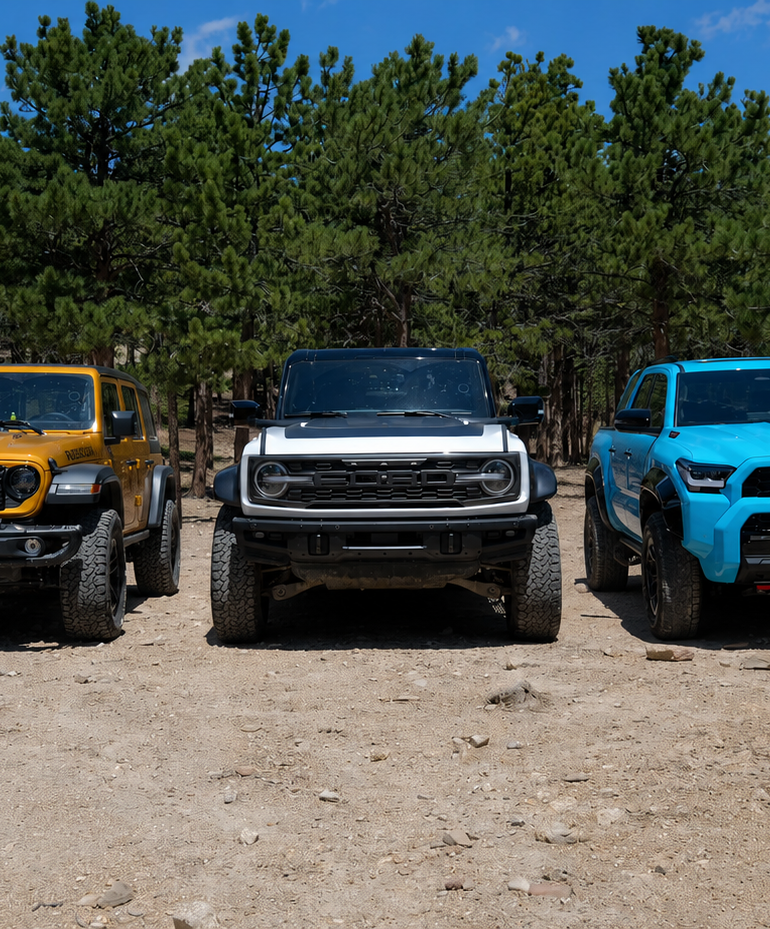
Few questions generate more debate among off-road enthusiasts than which manufacturer builds the best 4×4. To put three of the segment’s most capable factory offerings to a meaningful test, TFLoffroad brought together the Jeep Wrangler 392, Ford Bronco Raptor, and sixth-generation Toyota 4Runner TRD Pro for a technical assault on Colorado’s Razor Rocks trail.
The comparison is revealing because these vehicles approach off-road engineering from fundamentally different directions. The Wrangler emphasizes traditional solid-axle articulation and V8 character, the Bronco Raptor combines enormous tires with long-travel independent suspension, while the 4Runner prioritizes electronic traction management, modern comfort, and everyday usability.
Razor Rocks provides an appropriate proving ground. The trail features roughly four feet of sharply contoured rock, demanding careful line selection, wheel articulation, traction management, ground clearance, and driver visibility. It also exposes the compromises inherent in each platform.
Wrangler 392: Old-School Hardware, Big-Cylinder Character
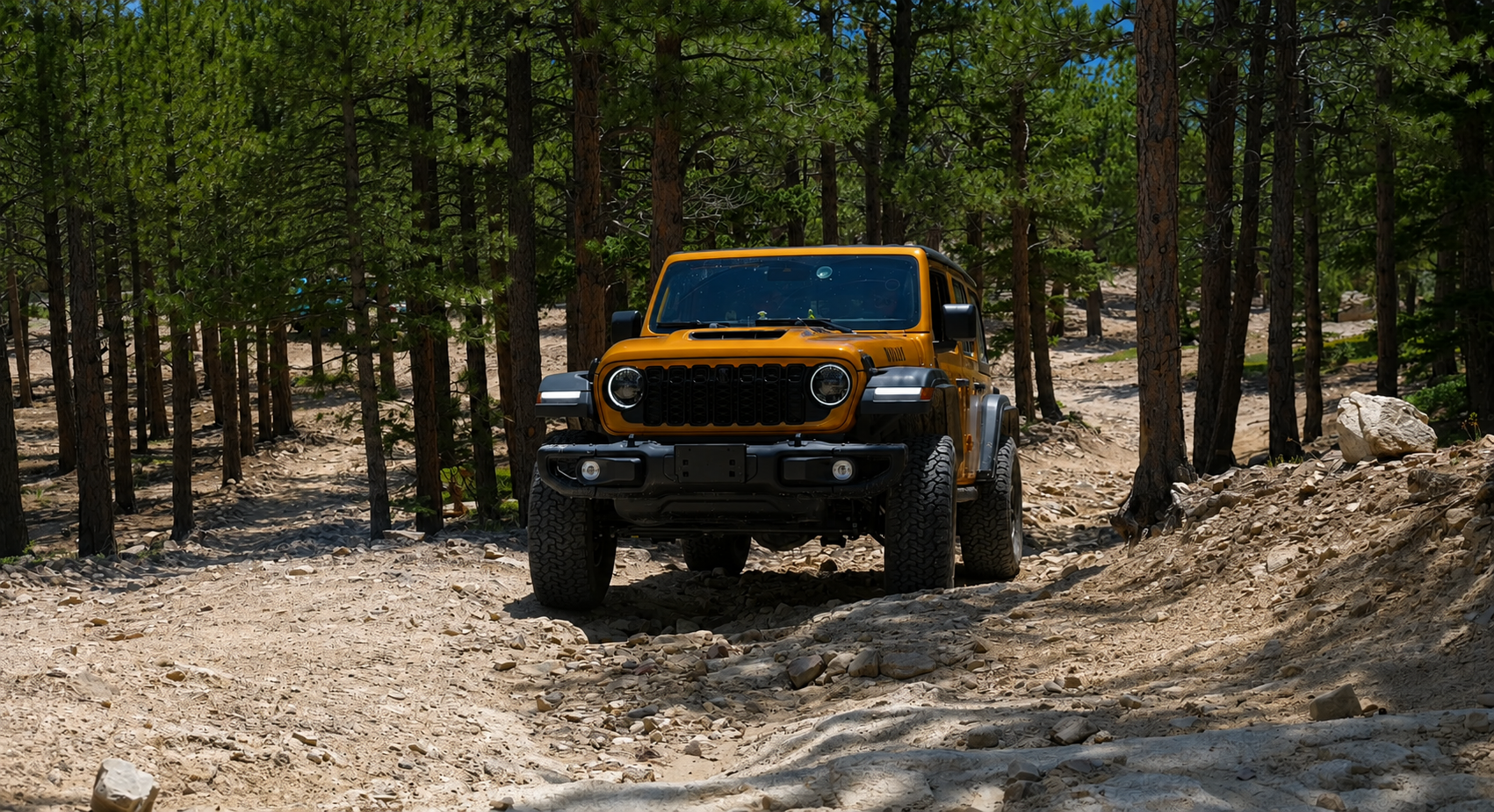
The Wrangler 392 remains the most mechanically traditional vehicle of the three, and its defining feature is the 6.4-liter HEMI V8. Producing 470 hp and 470 lb-ft of torque, the engine is paired with an eight-speed automatic transmission and fundamentally changes the personality of the Wrangler.
For this evaluation, however, the Wrangler is a Willys 392 rather than a fully equipped Rubicon or Moab 392. It rides on 35-inch tires and retains a rear locking differential, but lacks a front locker and electronically disconnecting front sway bar. Despite those omissions, its solid front and rear axles provide impressive articulation.
On Razor Rocks, the Wrangler demonstrated that sophisticated equipment is not always essential when the underlying mechanical architecture is inherently capable. Its traction-control system effectively compensated for the absence of a front locker, while the solid axles helped keep the tires planted across uneven terrain.
The Wrangler’s strengths extend beyond the trail. Its physical controls, analog gauges, excellent forward visibility, and familiar cabin layout make it easy to operate in demanding environments. Yet those same traditional characteristics produce compromises on pavement. The solid axles contribute to a less refined ride and steering response than the Ford and Toyota, while throttle modulation in low range can feel somewhat abrupt.
For approximately $75,000 in the configuration tested, however, the Wrangler delivers something neither competitor can replicate: a large-displacement naturally aspirated V8 in a relatively compact, trail-focused package.
Bronco Raptor: Suspension as a Weapon
If the Wrangler represents traditional rock-crawling philosophy, the Bronco Raptor represents the modern high-performance interpretation of off-roading.
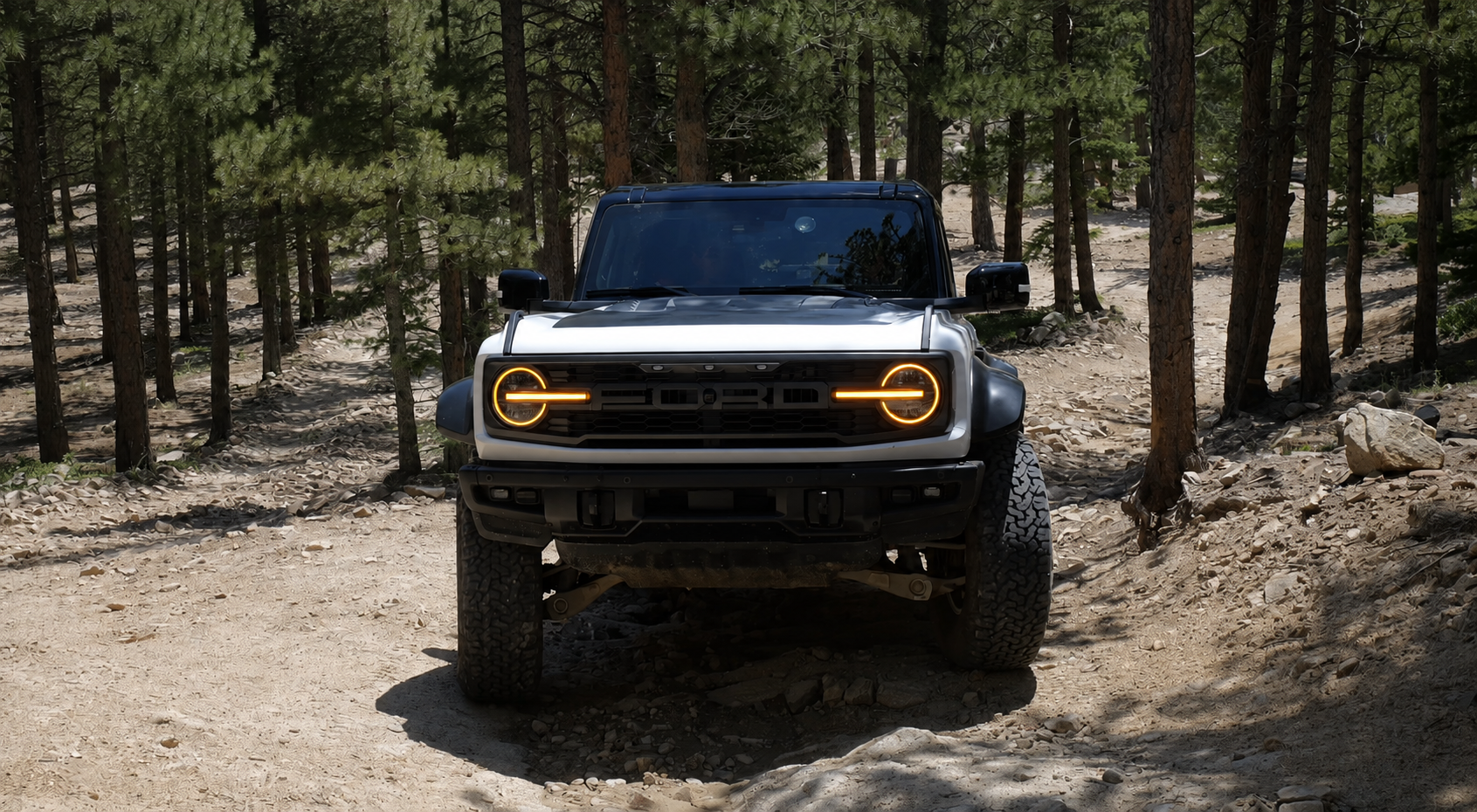
Its 37-inch tires immediately give it a substantial advantage. The Bronco offers approximately 13.1 inches of ground clearance, a 47-degree approach angle, and dramatically more suspension travel than its rivals. Its independent front suspension is engineered specifically for articulation, while the rear suspension provides approximately 14 inches of travel.
Power comes from Ford’s 3.0-liter EcoBoost V6, producing 418 hp and 440 lb-ft of torque through a 10-speed automatic transmission. Although it lacks the emotional soundtrack of the Jeep’s V8, the turbocharged engine provides substantial performance and considerable tuning potential.
The Bronco’s electronic systems further enhance its capability. Its selectable front and rear lockers, GOAT drive modes, full-screen trail camera, and off-road cruise-control system provide an extensive suite of tools for negotiating difficult terrain.
On Razor Rocks, the Raptor was the standout performer. Its combination of tire size, suspension travel, approach angle, and clearance allowed it to negotiate obstacles with remarkably little drama. The suspension maintained tire contact over terrain that challenged the other vehicles, while the lockers provided additional control when traction became limited.
There is a price for that capability. At roughly $95,000, the Raptor costs about $20,000 more than the Jeep and Toyota. Its substantial width can also become a disadvantage on narrow trails, particularly those surrounded by trees.
The Raptor’s engineering is arguably optimized for high-speed off-roading, meaning its capabilities can exceed what many Colorado trails allow drivers to exploit. Nevertheless, as a factory-built off-road performance vehicle, its hardware is extraordinarily comprehensive.
4Runner TRD Pro: The Rational Choice
The sixth-generation 4Runner TRD Pro takes a different approach. Rather than attempting to match the extreme mechanical specification of the Wrangler and Bronco, Toyota has created a vehicle intended to balance genuine trail capability with superior everyday usability.
Its 2.4-liter turbocharged four-cylinder hybrid powertrain produces 326 hp and 465 lb-ft of torque. The hybrid system contributes strong low-speed torque and helps deliver an EPA-rated 23 mpg combined, giving the Toyota a significant efficiency advantage over its larger-engined competitors.
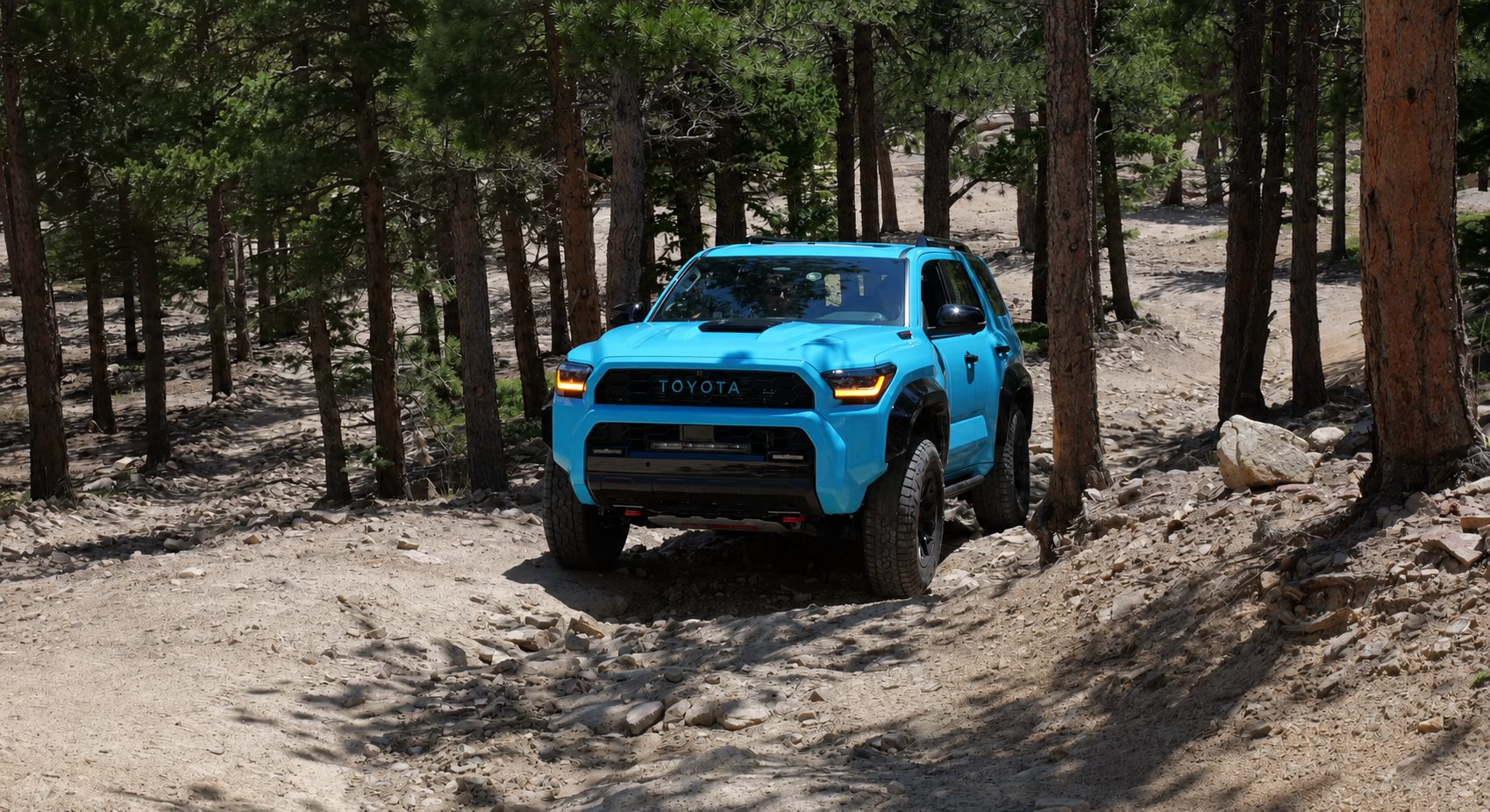
Off-road equipment includes a locking rear differential, disconnecting stabilizer bar, substantial skid protection, and Toyota’s sophisticated traction-control programming and Crawl Control system. Notably, the 4Runner does not offer a front locker.
That limitation becomes apparent on Razor Rocks. The Toyota required more wheelspin and momentum than the Jeep and Ford, and its comparatively modest 33-inch tires, 33-degree approach angle, and 10.1 inches of ground clearance put it at a disadvantage. The vehicle nevertheless cleared obstacles that could easily defeat less capable SUVs.
Toyota’s camera system is particularly useful, with side-mounted views that allow the driver to monitor the front wheels around obstacles. Forward visibility, however, is compromised by the TRD Pro’s hood design.
Where the 4Runner decisively wins is on the road. Its quieter, smoother, more car-like character, ventilated seats, modern technology, wireless charging, sunroof, power rear window, and comfortable ride make it considerably easier to live with on a daily basis. With more than 5,000 pounds of towing capacity and an integrated brake controller, it also offers practical utility beyond recreational trail driving.
Three Winners for Three Different Priorities
The Razor Rocks test ultimately illustrates that there is no universal definition of the best 4×4.
The Ford Bronco Raptor emerged as the strongest performer of the day. Its 37-inch tires, exceptional clearance, long-travel suspension, locking differentials, and sophisticated chassis engineering gave it a clear technical advantage over the other two vehicles.
The Jeep Wrangler 392, however, remained the most emotionally compelling machine. Its V8 transforms the Wrangler experience, while its narrower dimensions and solid axles make it particularly well suited to the tighter trails found throughout Colorado. It is less refined on pavement, but that ruggedness is part of its appeal.
The Toyota 4Runner TRD Pro occupies the opposite end of the spectrum. It is not the most capable rock crawler in this comparison, but it is arguably the most sensible vehicle for an owner who spends far more time on pavement than on technical trails. Its modern powertrain, comfortable cabin, advanced technology, efficiency, and strong all-around usability make it the most practical choice.
The resulting verdict is remarkably clear: the Bronco Raptor is the most capable, the Wrangler 392 is the most fun, and the 4Runner TRD Pro is the smartest.
That distinction is ultimately what makes this comparison so compelling. Rather than producing a single definitive winner, Razor Rocks demonstrates how dramatically three manufacturers can interpret the same basic mission—and how those engineering decisions influence everything from wheel placement on a four-foot rock obstacle to the experience of driving home afterward.
Source: TFLoffroad