

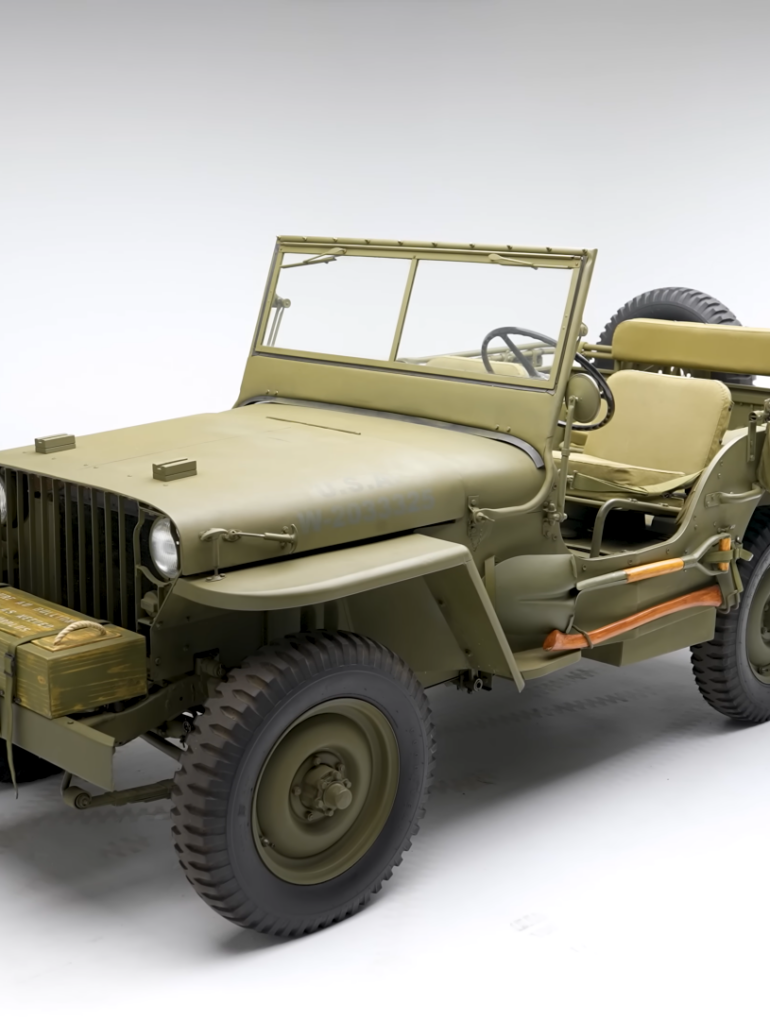
The 1941 Willys MB was born from a military requirement for something radically practical: a compact, lightweight, four-wheel-drive vehicle capable of reconnaissance, troop transport, communications, weapons carriage, and battlefield support. What emerged became one of the most influential military vehicles ever produced and the foundation for the modern Jeep.
A Military Vehicle for a New Kind of War
As war approached in Europe during the late 1930s, the U.S. military recognized that motorcycles and horses could no longer provide the mobility required by modern warfare. The Army needed a small vehicle that was fast, maneuverable, four-wheel drive, easy to manufacture, and simple enough to repair in the field.
The specifications were demanding. The vehicle had to remain within strict limits for weight and dimensions while delivering sufficient power and, critically, mechanical simplicity. Components needed to be accessible and repairable by soldiers operating far from conventional workshops.
From American Bantam to Willys
American Bantam was the first manufacturer to develop a vehicle resembling the eventual Jeep. The company had descended from the American Austin operation and already specialized in compact automobiles. Its military prototype demonstrated that a small, four-wheel-drive utility vehicle could satisfy the Army’s requirements.
When the government sought production, Willys and Bantam responded, but the Army recognized that additional manufacturing capacity would be necessary. Ford was subsequently brought into the program. The result was a standardized military vehicle produced by multiple manufacturers rather than a platform defined by a single company.
This approach was critical to wartime logistics. The military wanted interchangeable components rather than separate Ford, Willys, and Bantam systems. A soldier in the field could not afford to depend on a manufacturer-specific supply chain when replacement parts might be hundreds or thousands of miles away.
American Bantam eventually concentrated on other wartime production, including trailers and components, while Willys and Ford handled the majority of Jeep production.
Where Did the Name “Jeep” Come From?
The origin of the name Jeep remains uncertain. Several explanations have survived, including the idea that it evolved from military terminology such as GP or GPW. Another theory connects the name to the term “general purpose,” reflecting the vehicle’s intended versatility.
A third explanation points to Eugene the Jeep, a character from the Popeye comic universe. Eugene was an unusually capable creature able to overcome obstacles and navigate difficult environments. In practical terms, the association proved remarkably appropriate for the military vehicle.
The 1941 Willys MB
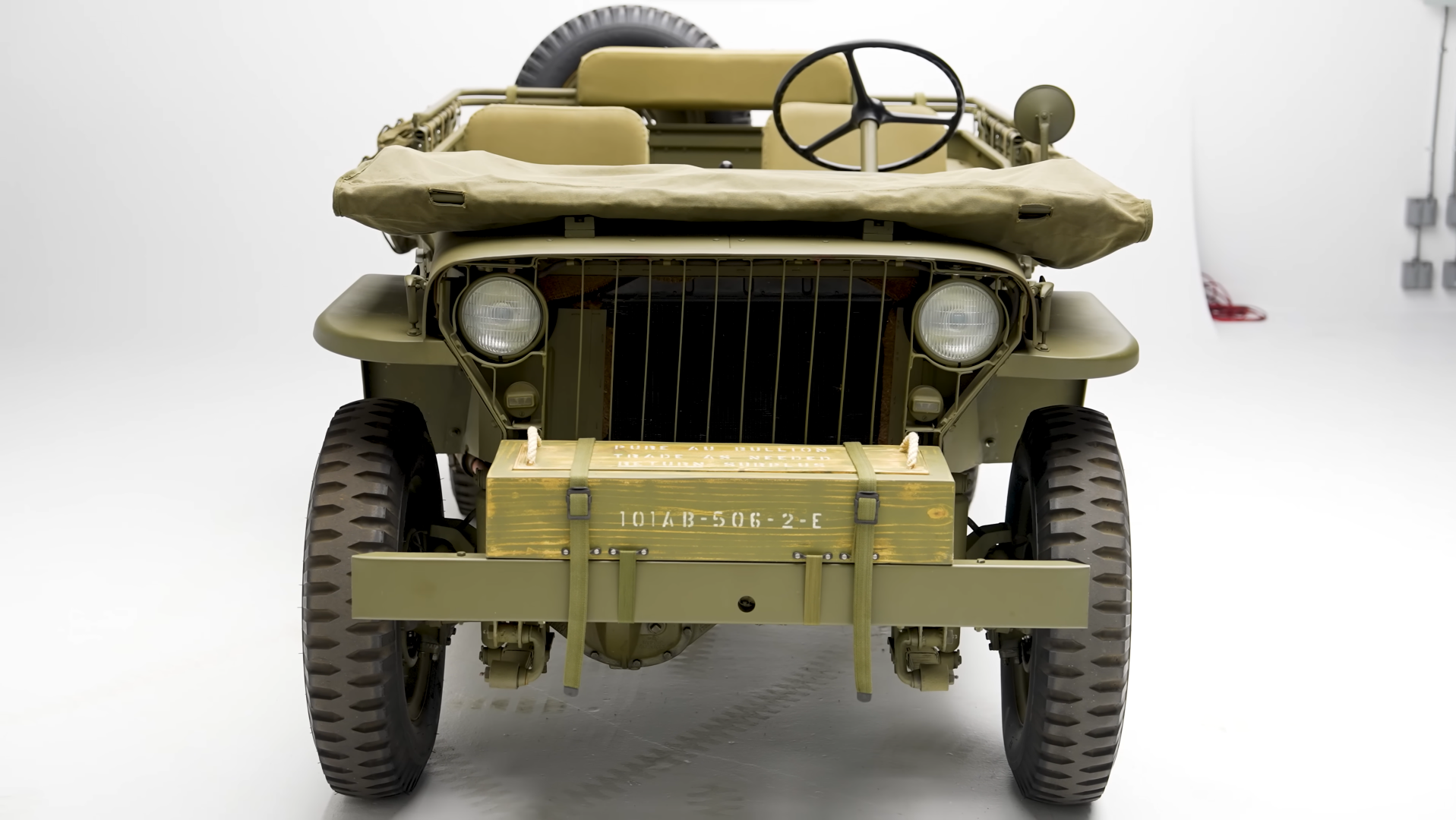
The Peterson Automotive Museum’s example is particularly important because it represents a very early Willys MB built before the attack on Pearl Harbor. It is a “slat-grille” Jeep, one of the earliest configurations produced by Willys.
The slat grille used individual vertical metal bars. Later production moved toward a stamped grille design, eventually establishing the familiar seven-slot configuration. Early versions initially used nine slots before the standardized seven-slot arrangement appeared.
This makes the vehicle an important link between the experimental military prototypes and the standardized Jeep that would become ubiquitous during World War II.
Form Follows Function
The Willys MB was engineered around one overriding principle: nothing should be included unless it served a practical purpose.
The windshield could fold flat, while the canvas top could be quickly installed or removed. The rear compartment could accommodate a machine gun, ammunition, medical equipment, or an ambulance litter. External mounting provisions allowed soldiers to carry tools such as a shovel and pickaxe—equipment that could become essential when the vehicle encountered terrain it could not simply drive through.
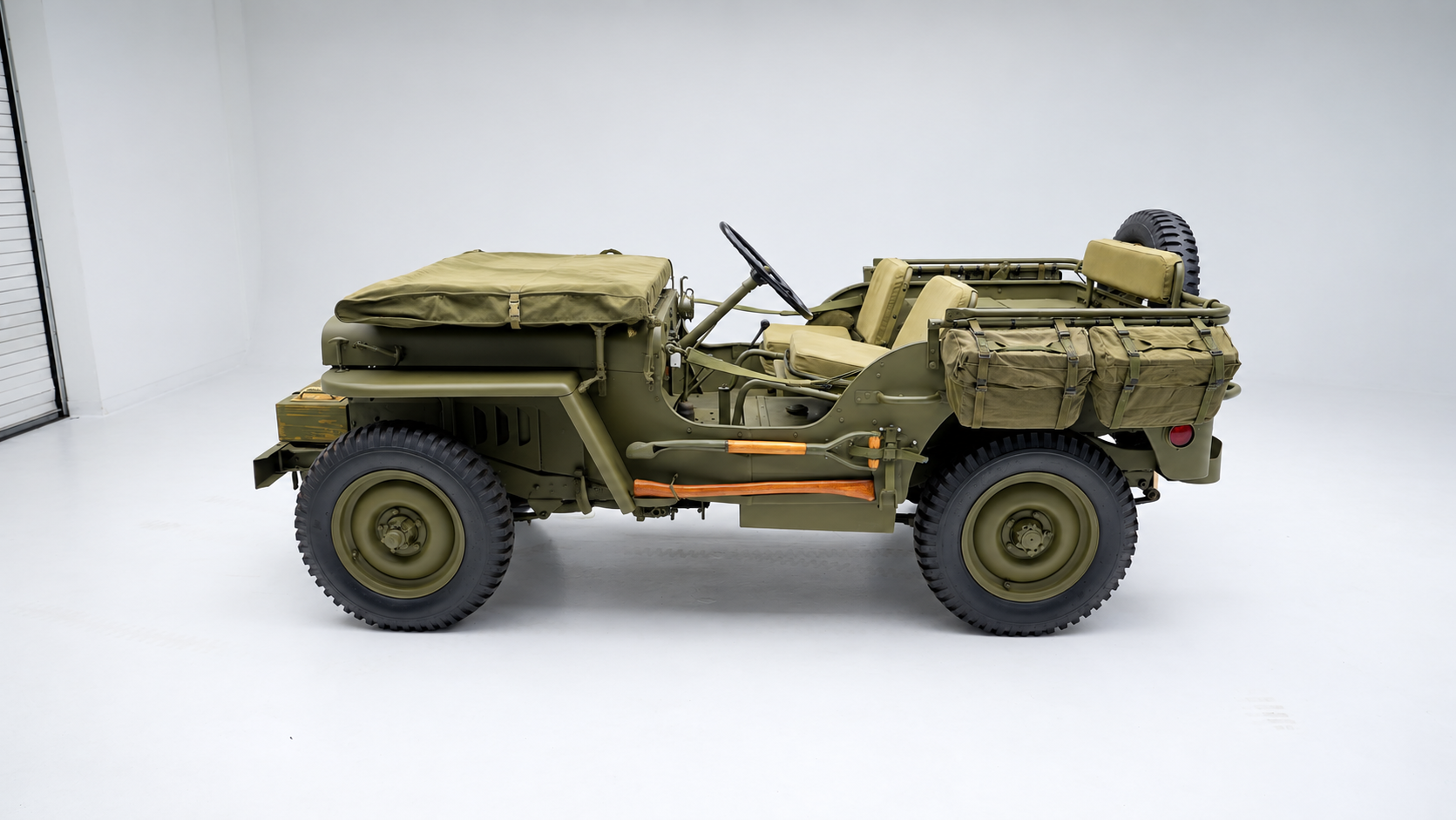
Even seemingly minor details reflected battlefield requirements. Storage areas could carry ammunition, rations, meals, or medical supplies, while hand grips at the rear gave occupants something to hold onto across rough terrain and provided additional options when the Jeep needed to be pushed or recovered.
A Spartan Interior Built for Soldiers
The cabin was deliberately austere. There was no decorative trim, unnecessary instrumentation, or civilian-style comfort equipment. The dashboard and controls were designed to be immediately understandable, with simple switches for lighting, choke, throttle, and instrument illumination.
The Jeep’s blackout lighting system was particularly important in combat. Conventional headlights could be avoided in favor of specialized blackout lamps designed to reduce the vehicle’s visibility to an enemy at distance or from above.
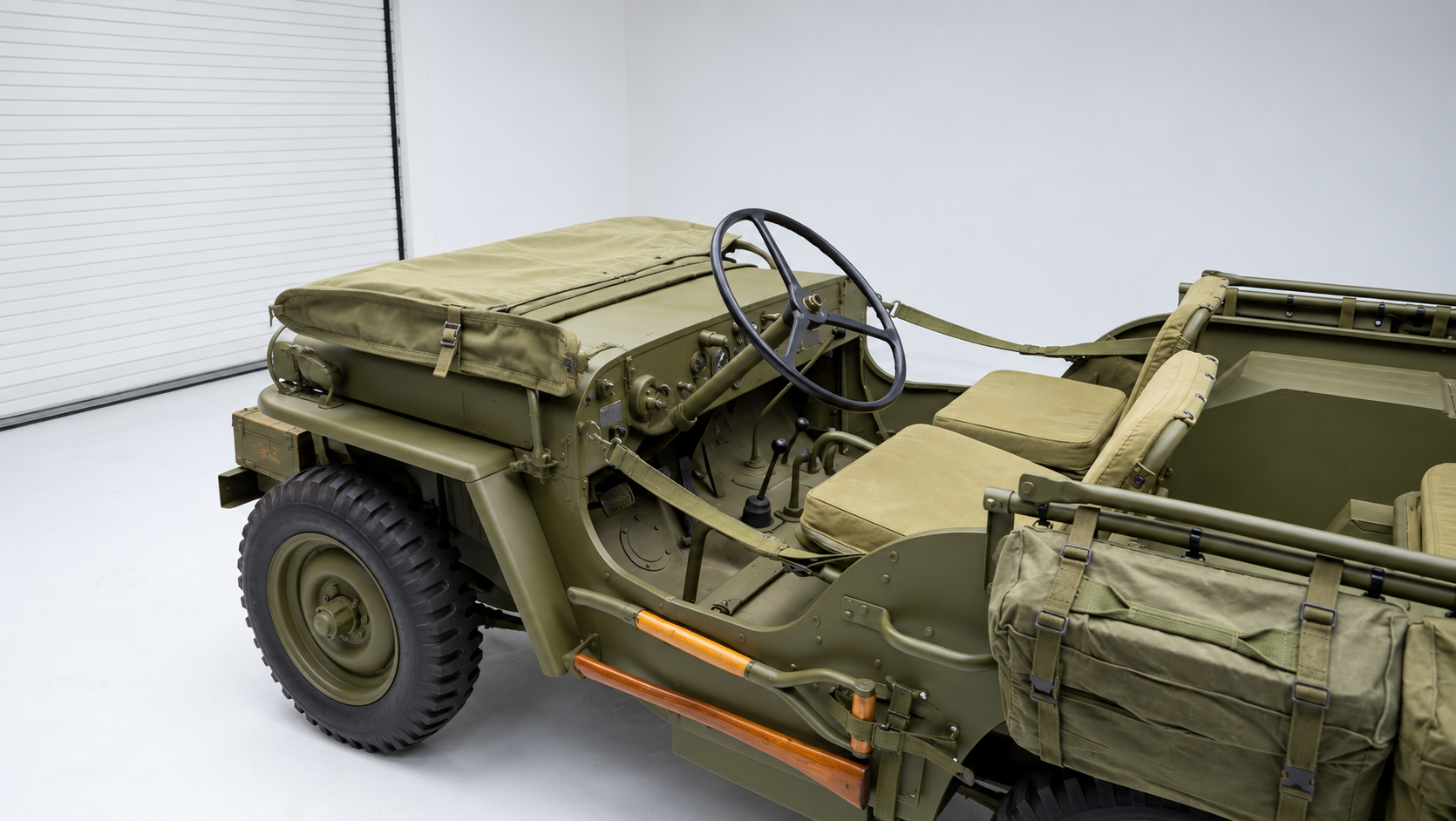
The windshield was similarly practical. It could be folded down when necessary, while manually operated windshield wipers eliminated reliance on an electric motor or complicated mechanism. In an environment where mechanical failure could have serious consequences, simplicity was a form of reliability.
Four-Wheel Drive and Battlefield Mobility
The Jeep’s defining advantage was its four-wheel-drive system. Unlike the motorcycles and sidecar combinations that had previously been considered for reconnaissance duties, the Jeep could drive all four wheels when conditions demanded it.
Its wheel placement, elevated bumper, and ground clearance were designed to provide the approach angle necessary to climb over uneven terrain. The result was a vehicle that could negotiate rises, rough ground, and obstacles that would challenge a conventional passenger car.
This capability transformed the Jeep into more than a simple transport vehicle. It could function as a reconnaissance platform, communications vehicle, weapons carrier, personnel carrier, or support vehicle depending on how it was configured.
The Flathead Engine
Power came from a simple four-cylinder flathead engine producing approximately 60 horsepower and about 105 lb-ft of torque. A single carburetor kept the system straightforward, while the engine compartment was laid out with accessibility in mind.
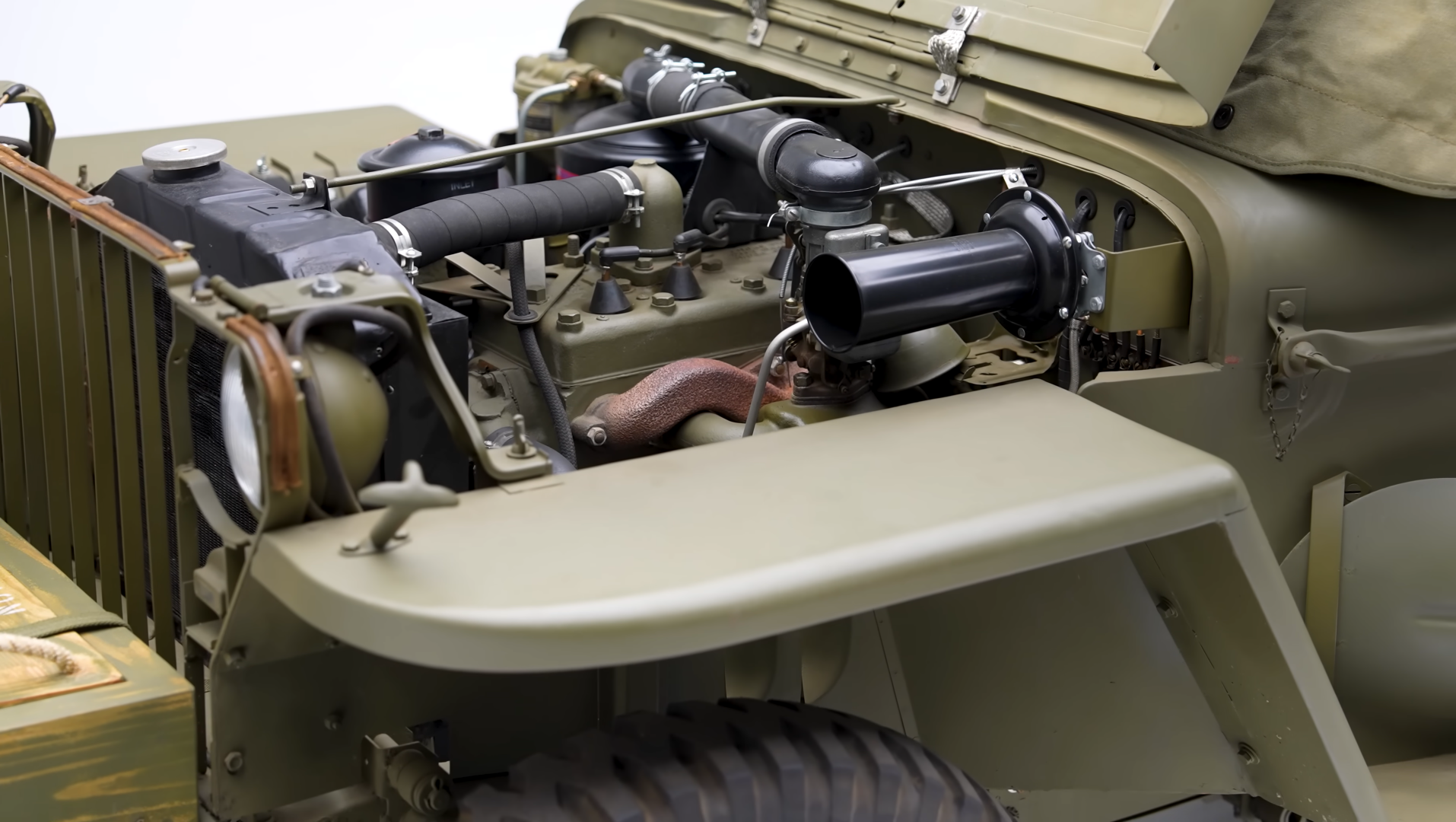
For specialized operations, a snorkel system could channel air from above the passenger compartment toward the carburetor. This was intended for applications such as beach landings and water crossings where the vehicle could be temporarily exposed to significant amounts of water.
The Jeep’s approximately 3,650-pound gross weight and 132-inch overall length gave it a compact footprint while retaining the durability and equipment-carrying capability required by the military.
Designed to Be Repaired in the Field
The Willys MB’s simplicity was not merely an aesthetic choice. It was a logistical strategy.
Hood latches were straightforward spring-loaded mechanisms, the windshield was manually operated, and the engine compartment left major components accessible. Even the hood could serve as a temporary flat working surface when the vehicle was stationary.
This philosophy extended throughout the vehicle. The military could not assume that a Jeep would always return to a maintenance facility after suffering damage. Soldiers needed a machine that could be understood, maintained, and repaired under difficult conditions.
The Jeep’s Wartime Legacy
The scale of Jeep production reflected how important the design became to Allied mobility. Approximately 640,000 quarter-ton Jeeps were produced during the war, making them one of the most numerous military vehicles of the conflict.
Their versatility was central to that success. The same basic vehicle could perform reconnaissance, transport personnel, carry weapons, move supplies, support communications, or serve as an improvised ambulance platform.
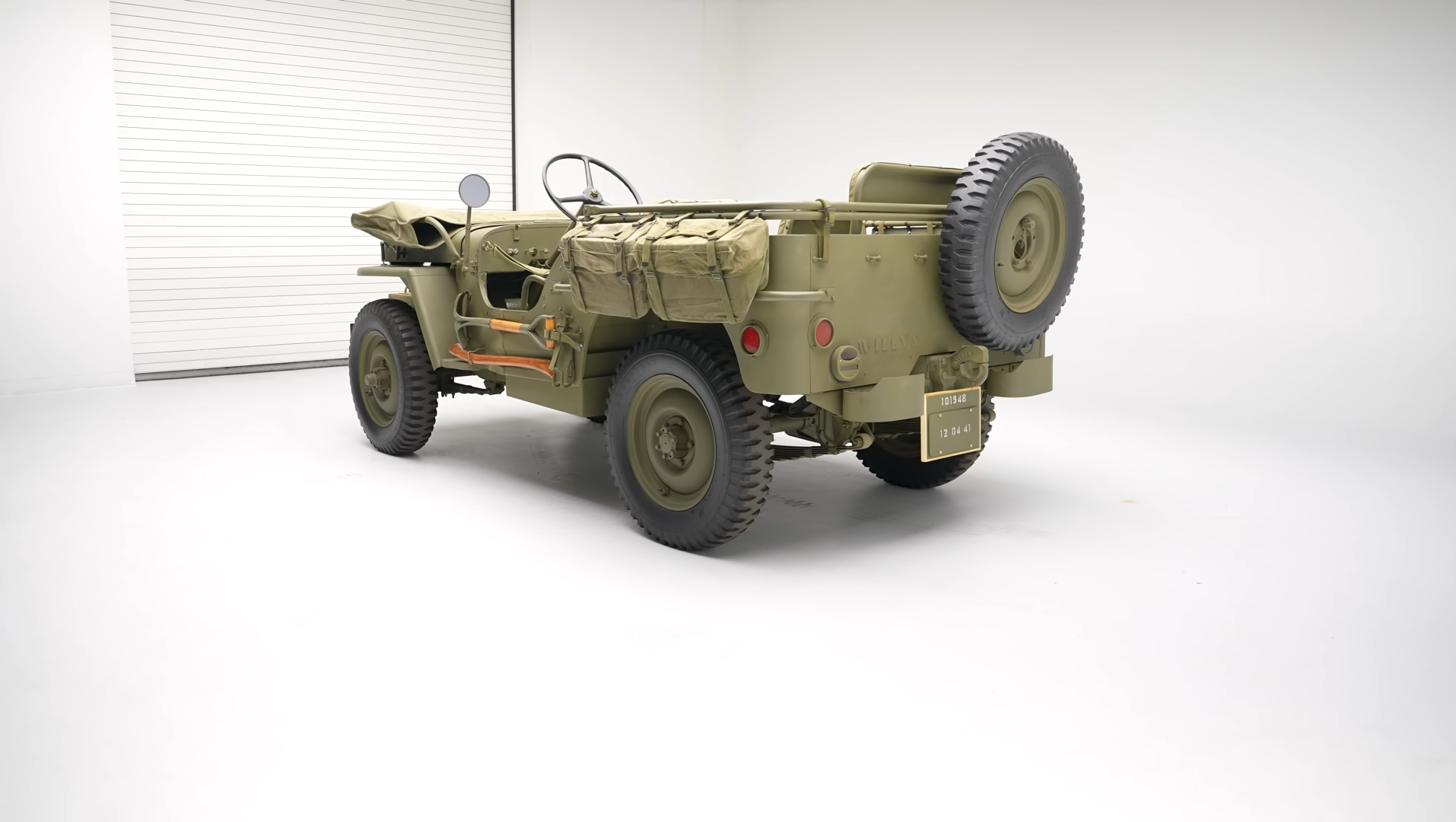
The Jeep therefore became more than another military vehicle. It became a standardized tool of mobility whose influence extended far beyond the battlefield.
The Beginning of the Modern SUV
The 1941 Willys MB occupies an important place in automotive history because its fundamental design philosophy anticipated characteristics that would later define the sport utility vehicle: four-wheel drive, compact dimensions, elevated ground clearance, versatile cargo capacity, and the ability to operate beyond paved roads.
Yet its original purpose was considerably more serious. This was not a lifestyle vehicle. Every component existed because soldiers needed it to perform a specific task.
The Jeep succeeded because it transformed military requirements into an exceptionally adaptable mechanical package. Its combination of simplicity, four-wheel-drive traction, compact dimensions, repairability, and versatility established a formula that would survive long after World War II ended.
A Vehicle That Became an Icon
The U.S. Army asked for a small utility vehicle capable of going almost anywhere. Willys, Ford, and American Bantam helped turn that requirement into reality, and the early Willys MB became the defining expression of the concept.
The 1941 Willys MB was therefore more than the first generation of a famous vehicle. It represented the moment when the military utility vehicle evolved into an entirely new automotive category.
Decades later, the Jeep name remains synonymous with four-wheel-drive mobility. The origins of that identity can be traced directly to machines such as this early Willys MB—small, austere, mechanically straightforward, and engineered with one objective above all others: get the job done.
Source: Petersen Automotive Museum