

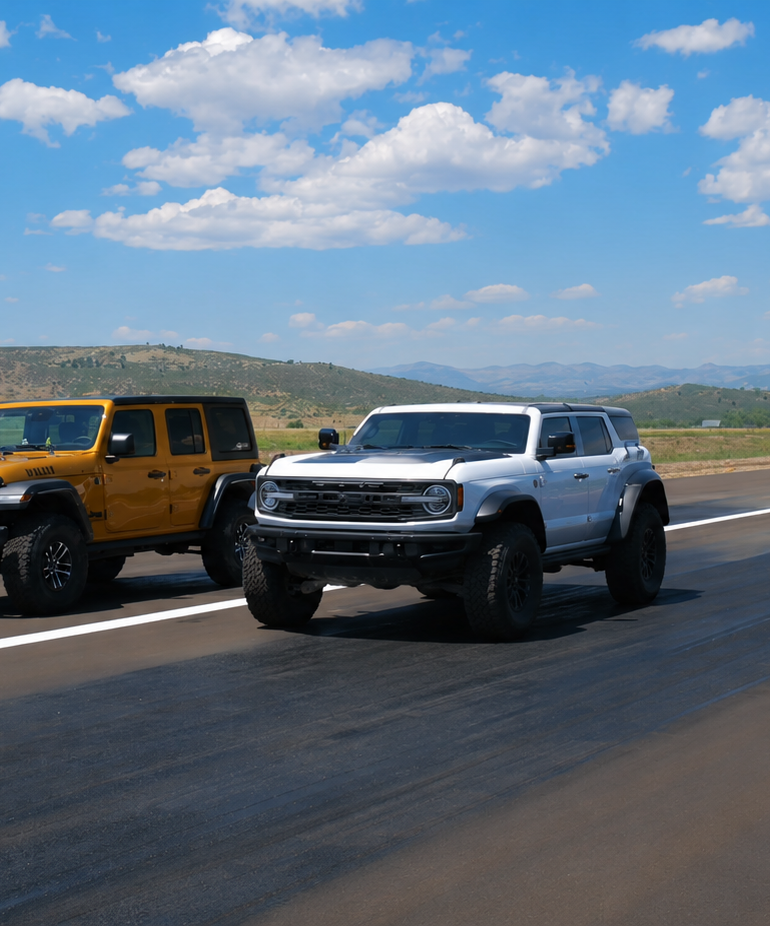
Four of the most recognizable names in the off-road world—the Toyota Land Cruiser, Ford Bronco Raptor, Jeep Wrangler 392, and Land Rover Defender Octa—were never designed primarily to dominate a drag strip. Yet that is precisely what The Fast Lane Car set out to discover, taking these high-performance adventure machines to an airfield quarter-mile to determine which “top dog” could deliver the strongest straight-line performance.
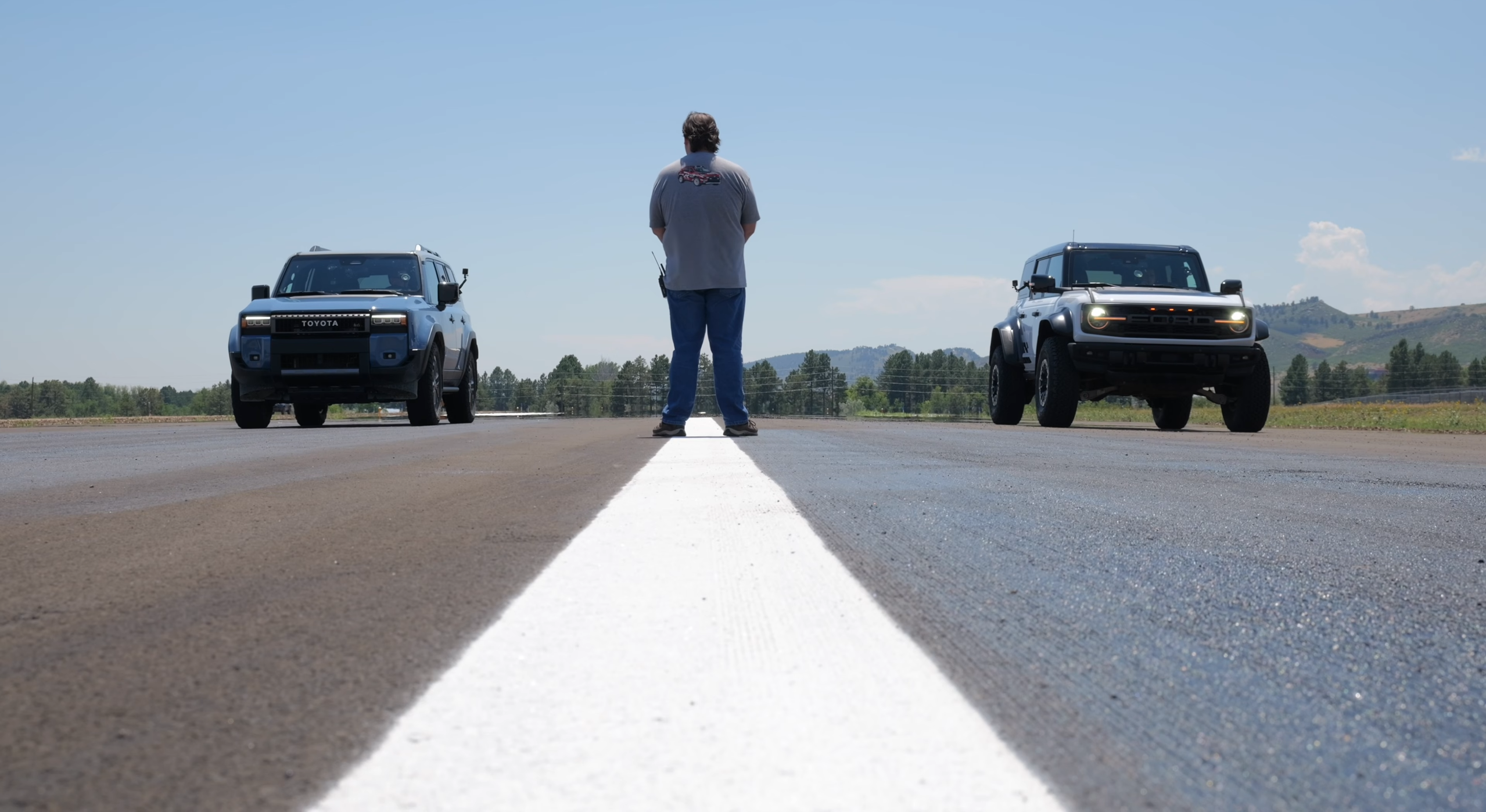
Ford Bronco Raptor vs. Toyota Land Cruiser
The opening matchup paired the Ford Bronco Raptor with the latest Toyota Land Cruiser. The Bronco Raptor brings a 3.0-liter twin-turbocharged V6 producing 418 hp and 440 lb-ft of torque, backed by a 10-speed automatic and four-wheel drive. Its opponent uses a 2.4-liter turbocharged four-cylinder hybrid powertrain rated at 326 hp and 465 lb-ft of torque.
Despite the Toyota’s impressive torque figure, the Ford immediately established a commanding advantage. The Bronco Raptor completed the quarter-mile in 15.24 seconds, reaching 60 mph in approximately 7 seconds. The Land Cruiser required 9.7 seconds to reach 60 mph and recorded a 17.12-second quarter-mile at roughly 75 mph.
The result highlighted an important distinction: torque alone does not determine acceleration. The Bronco’s broader powerband, aggressive transmission calibration, and twin-turbocharged engine gave it a decisive advantage.
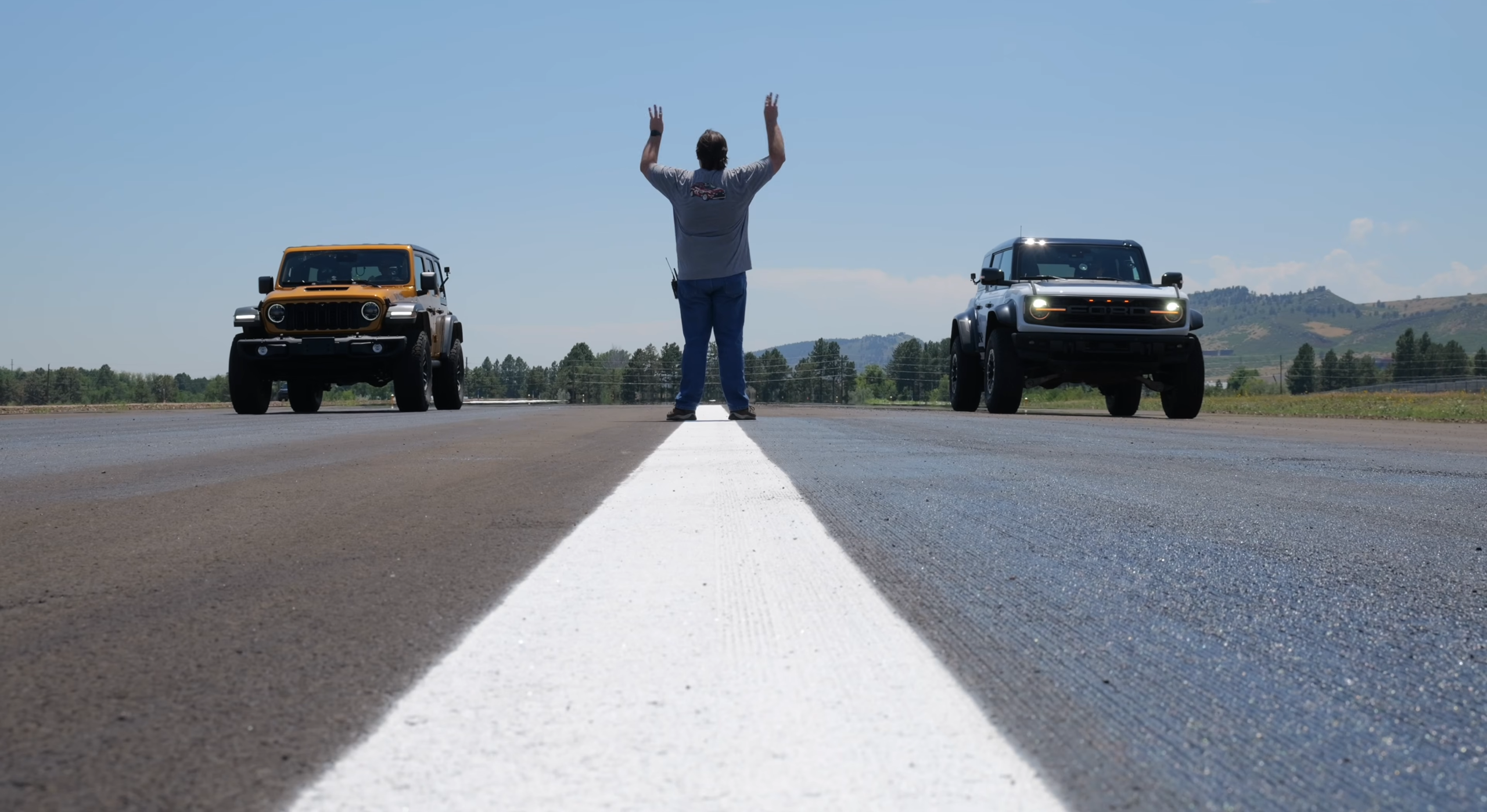
Jeep Wrangler 392 Takes on the Bronco
The Wrangler 392 brought considerably more displacement to the contest. Its naturally aspirated 6.4-liter V8 produces 470 hp and 470 lb-ft of torque, while an eight-speed automatic sends power to all four wheels.
The Jeep proved that old-school displacement still has plenty to offer. It reached 60 mph in 6.30 seconds and covered the quarter-mile in 14.63 seconds, comfortably beating the Bronco Raptor’s 15.3-second repeat run.
The Wrangler’s V8 soundtrack was equally dramatic, but its performance advantage came from more than noise. Immediate throttle response and abundant low-end torque allowed the 392 to launch hard and continue accelerating strongly through the quarter-mile.
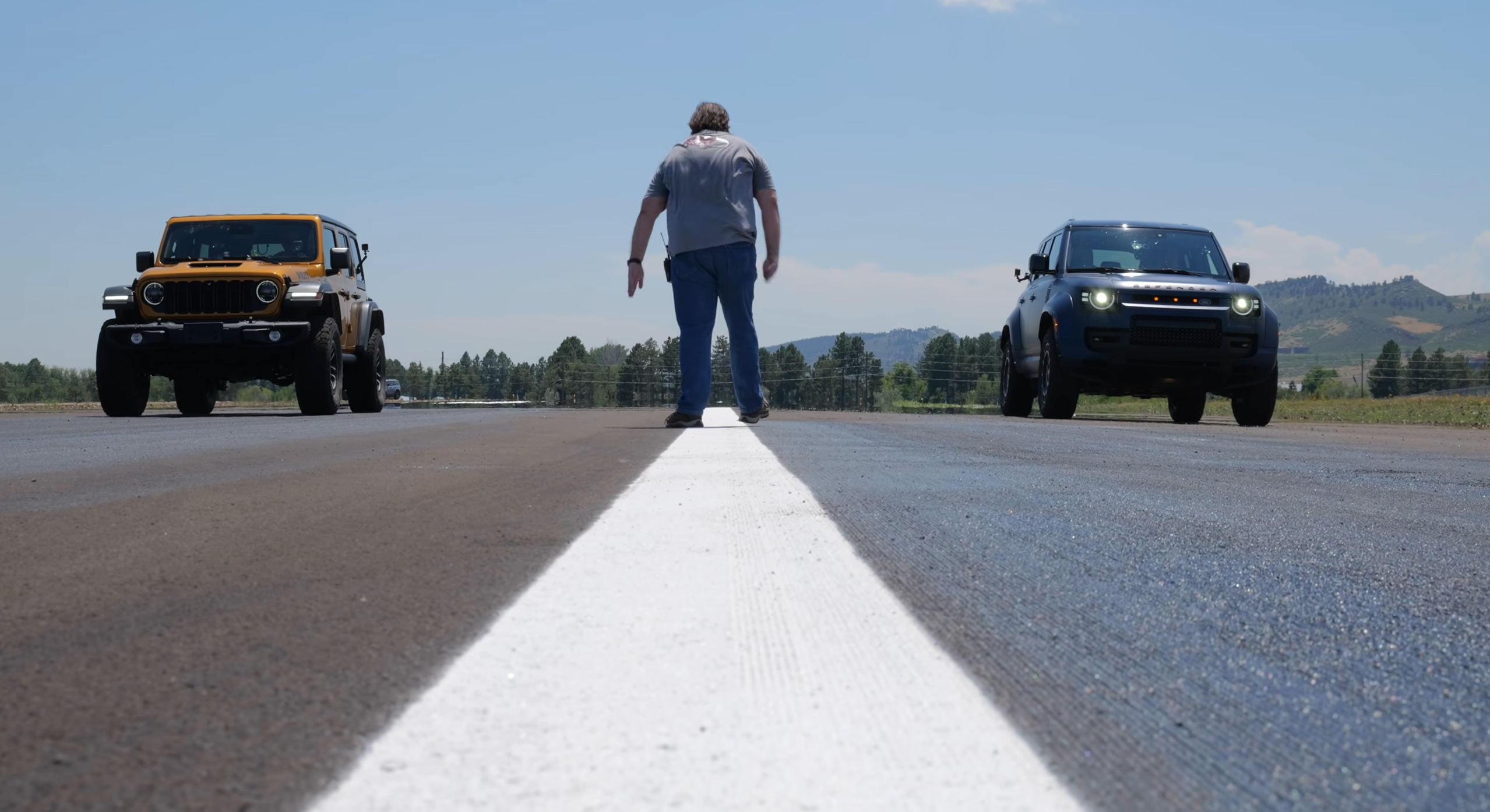
Defender Octa Changes the Game
The Land Rover Defender Octa elevated the competition substantially. Powered by a BMW-sourced 4.4-liter twin-turbocharged V8, the Octa produces 626 hp and 590 lb-ft of torque. Despite weighing approximately 6,000 pounds, its sophisticated chassis and launch-control system transformed it into a surprisingly serious performance machine.
At roughly a mile above sea level, the Defender recorded a 4.72-second 0-to-60-mph time and a 13.6-second quarter-mile, with subsequent runs dipping into the low-13-second range.
The Octa’s performance was particularly remarkable given its off-road-oriented tires, which limited both grip and top speed.
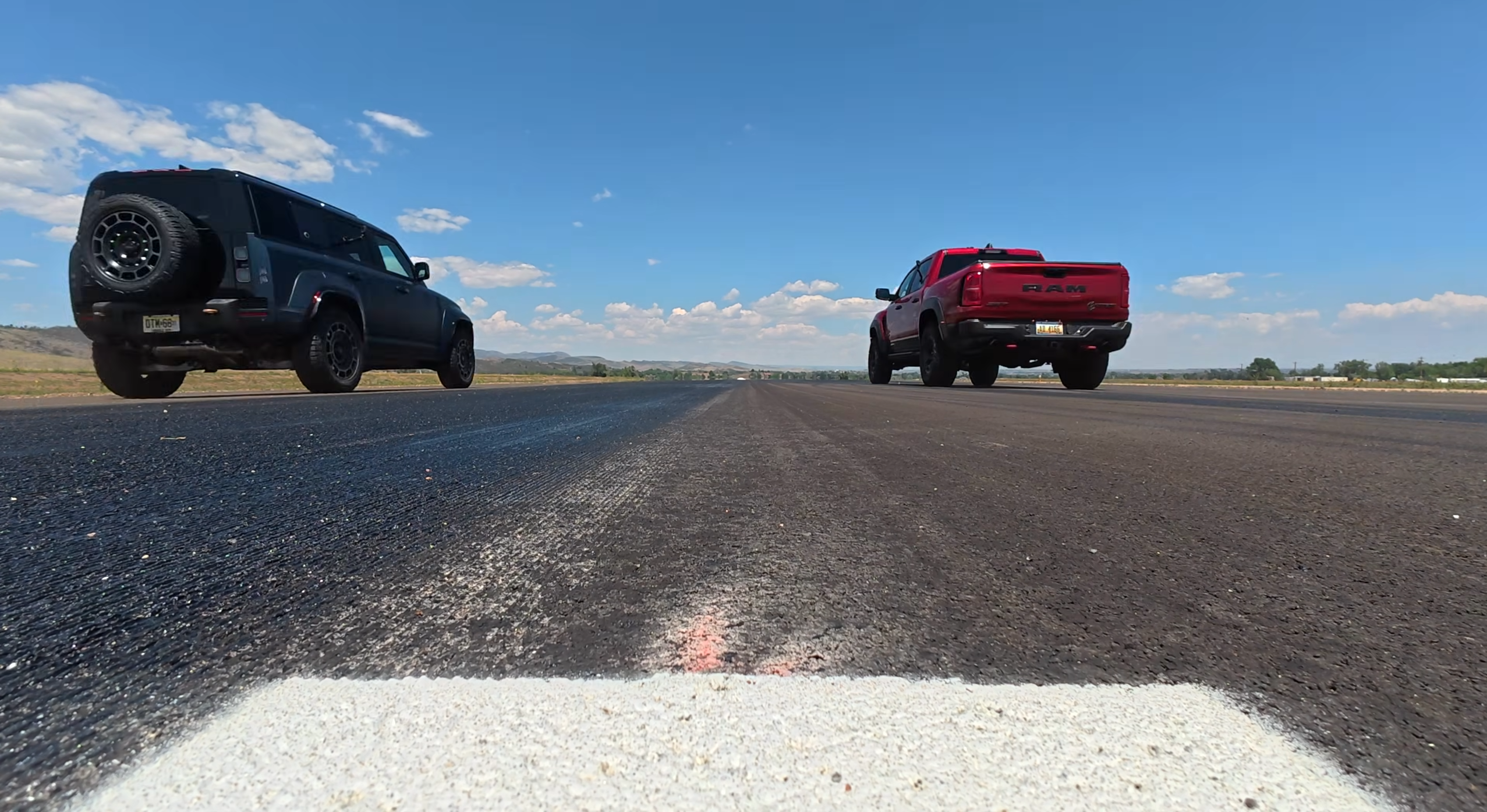
Ram TRX vs. Defender Octa
The final battle introduced the Ram TRX, armed with a supercharged 6.2-liter V8 producing 777 hp. The American pickup immediately became the most powerful contender, but the Defender’s lighter footprint and sophisticated launch strategy kept the contest remarkably close.
The TRX managed a best quarter-mile of approximately 13.31 seconds, while the Defender repeatedly posted times in the 13.3-second range. In one especially close run, the two machines were virtually inseparable, with the outcome determined by who gained the better launch.
Rolling races further exposed the TRX’s supercharged advantage. Unlike a turbocharged engine, the supercharger delivers immediate boost, allowing the Ram to respond almost instantly when the transmission kicks down. The Defender eventually closed the gap at higher speeds, but its off-road tires triggered a speed limiter at approximately 112 mph.
The Verdict
The drag strip proved that modern off-roaders can be remarkably quick despite their weight, ground clearance, and aggressive tires. The Toyota Land Cruiser was the clear underdog, while the Bronco Raptor delivered strong performance for its size. The Wrangler 392 demonstrated the enduring appeal of naturally aspirated V8 power, but the Defender Octa and Ram TRX ultimately occupied another performance tier.
More importantly, the results showed that these vehicles are not simply powerful versions of traditional off-roaders. They represent an increasingly sophisticated intersection of extreme trail capability and high-speed performance—and few automotive experiments demonstrate that evolution better than lining them up on an airfield and seeing which one reaches the finish first.
Source: The Fast Lane Car