

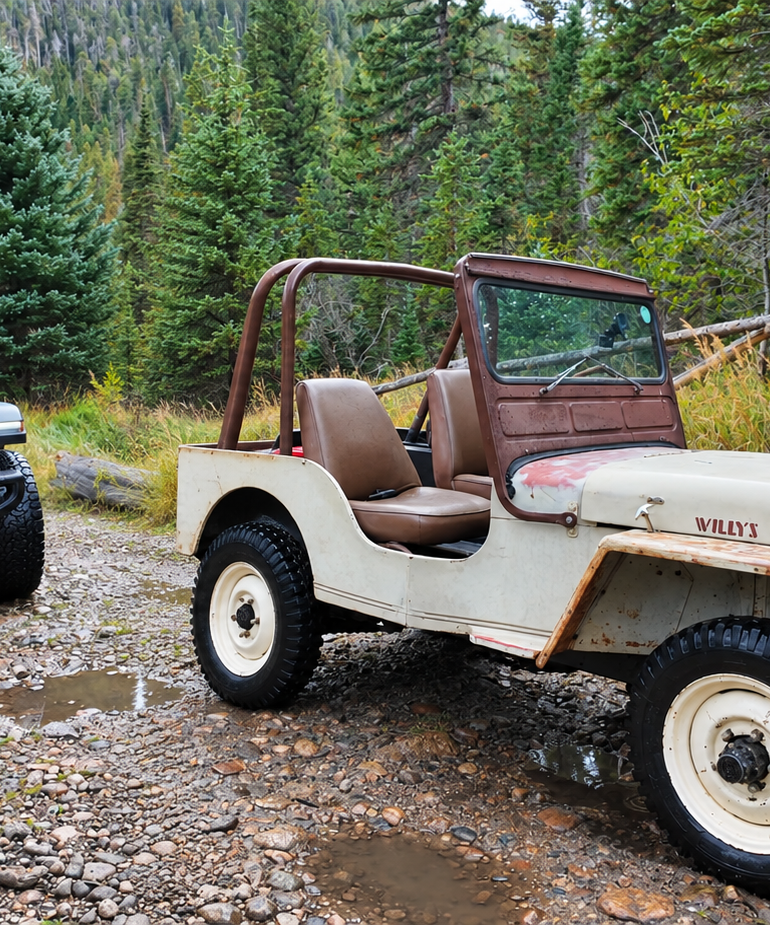
Eighty years of Jeep development separate the 1947 Willys CJ-2A from the modern Wrangler 392, yet both remain fundamentally focused on the same task: getting through difficult terrain. TFLoffroad put the two generations together on Colorado’s Middle St. Vrain trail, a route rated 6/10 on OnX Offroad, to examine how dramatically Jeep’s off-road formula has evolved.
The comparison was less about determining a conventional winner than understanding what has been gained—and lost—over eight decades.
Two Jeeps, Completely Different Philosophies
The 1947 CJ-2A represents the earliest civilian evolution of the military Jeep. The example tested by TFLoffroad remains largely faithful to its original configuration, including its compact dimensions and small non-directional tires. Its mechanical restoration includes a rebuilt transfer case and transmission, refreshed engine, new brakes and wiring, along with replacement components including the alternator, water pump, distributor, spark plugs and wires.
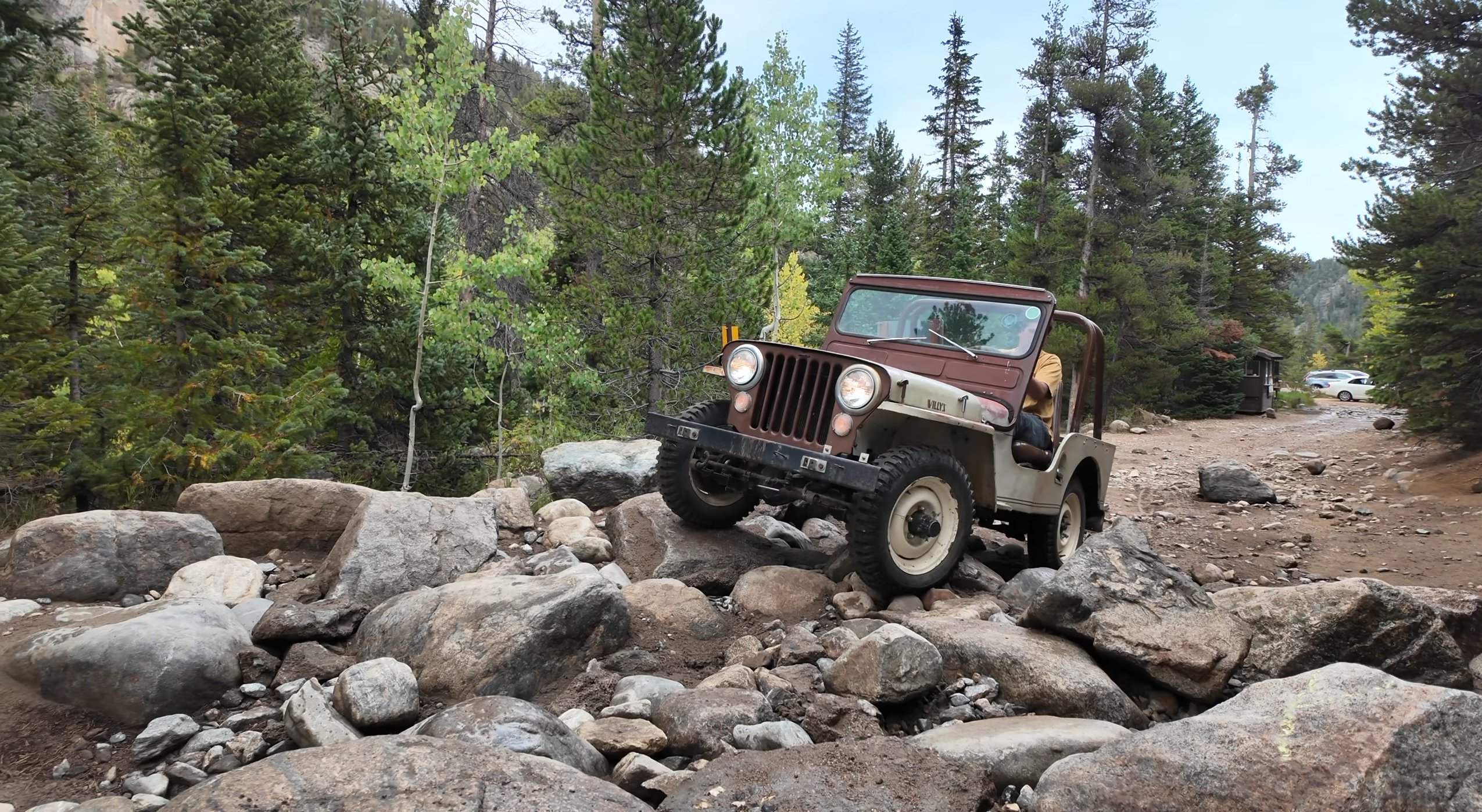
The restoration was still very much a work in progress, however. The CJ-2A had already demonstrated reliability issues during its shakedown period, and the Middle St. Vrain trail provided an immediate reminder that vintage off-road machinery demands considerably more mechanical attention than a modern Jeep.
The Wrangler 392 occupies the opposite end of the engineering spectrum. Its 6.4-liter HEMI V8 produces 470 horsepower, while factory 35-inch tires, substantial ground clearance, low-range gearing and electronic traction management give it an enormous advantage in difficult terrain.
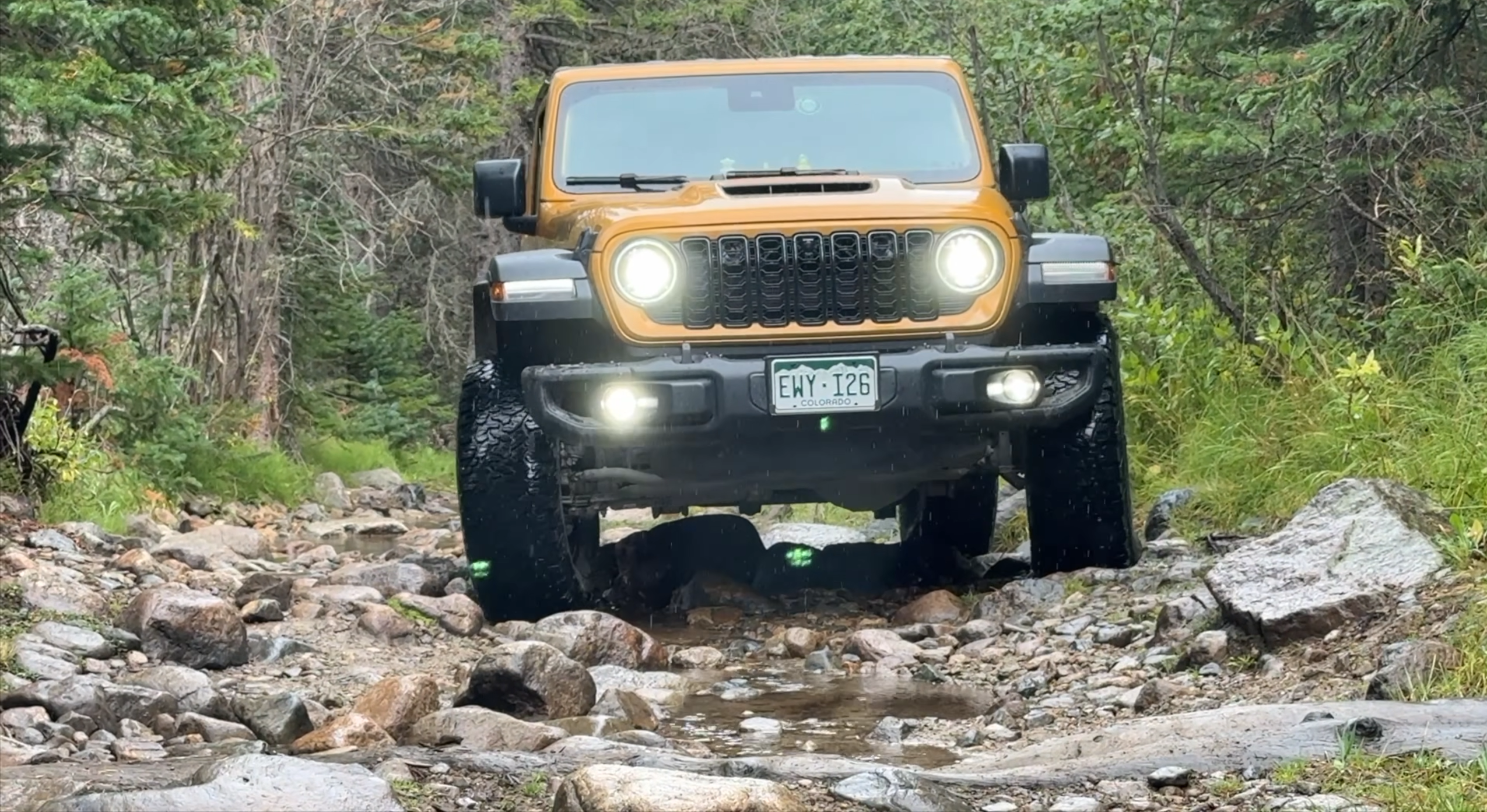
This particular Wrangler was a Willys rather than a Rubicon or Moab 392. Consequently, it lacked a front locking differential and electronic sway-bar disconnect, retaining a rear locker and sophisticated traction-control system. Even without those additional features, its mechanical and electronic capabilities dwarfed those of the 1947 Jeep.
The Gatekeeper Exposes the Difference
The first major obstacle on Middle St. Vrain immediately demonstrated the contrast.
The Wrangler tackled the rock garden in low range with Off-Road+ engaged and initially without using its lockers. Its combination of suspension articulation, tire size, traction control and ground clearance allowed it to negotiate the rocks with relatively little drama.
The CJ-2A encountered a completely different problem. A rock contacted the driver’s-side clutch linkage, effectively preventing the clutch mechanism from operating. Because the vehicle weighs only about 2,400 pounds, the crew could manually rock and push it enough to free the linkage before eventually using a tow strap.
It was an appropriate demonstration of the two vehicles’ fundamental differences. The modern Wrangler is engineered to isolate vulnerable components and maintain mobility over obstacles. The CJ-2A’s exposed mechanical architecture is considerably more vulnerable to interference from terrain.
The incident also illustrated one of the vintage Jeep’s advantages: simplicity. When something went wrong, the problem was visible, accessible and potentially repairable with basic tools.
Small Tires, Small Dimensions
Once back underway, the CJ-2A began demonstrating why its basic architecture remains so effective.
Its narrow body and compact footprint allow it to pick unconventional lines through terrain. Rather than climbing directly over every obstacle, the driver can frequently maneuver around rocks that would force a larger vehicle into a more difficult position.
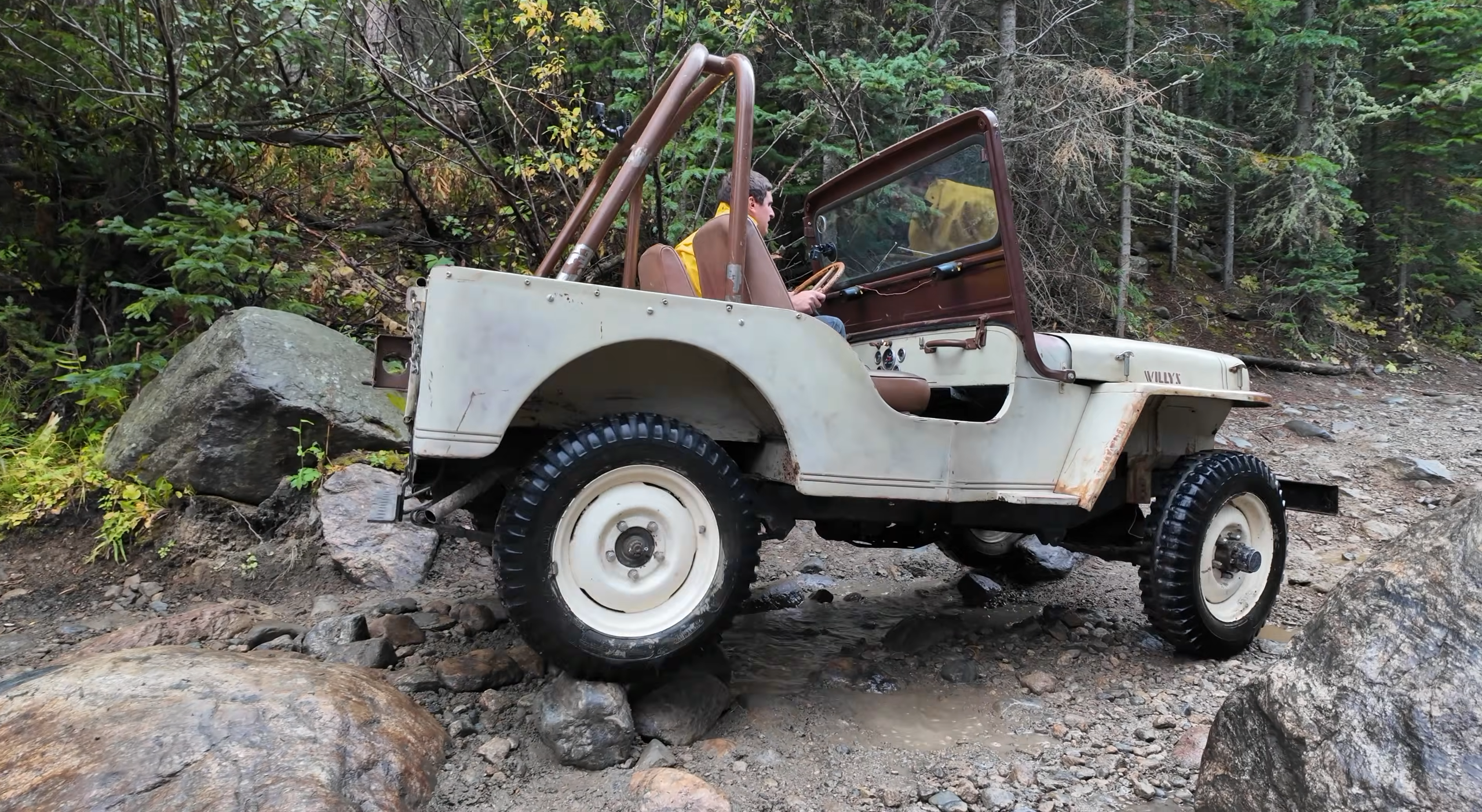
That agility is particularly valuable on narrow trails.
The CJ-2A’s suspension and tire technology, however, require the driver to adapt. Unlike the controlled crawling behavior of a modern Wrangler, the vintage Jeep tends to bounce and skip across uneven surfaces. That isn’t necessarily a defect; it reflects the engineering priorities of an era when low weight, simplicity and basic mobility mattered more than ride quality.
The Wrangler’s 35-inch tires and significantly greater suspension capability make obstacles much less consequential. Its driver can approach terrain with considerably more confidence and considerably less physical punishment.
The Reliability Test
The CJ-2A’s biggest challenge wasn’t necessarily the trail itself. It was keeping the engine supplied with fuel.
After the initial clutch-linkage problem, the Jeep developed another issue that appeared to involve fuel delivery. The crew traced the problem to a secondary fuel filter that had become restricted. Cleaning the filter restored fuel flow sufficiently to get the Jeep moving again.
The episode was a reminder of what separates a restored vintage Jeep from a modern production vehicle. The CJ-2A had undergone extensive mechanical work, yet it remained in its shakedown phase. Fuel-system restrictions, electrical problems and an increasingly severe exhaust leak were still part of the ownership experience.
The Wrangler, by comparison, simply kept moving.
That distinction matters when evaluating these vehicles as actual transportation. The modern Jeep can be driven to the trail, subjected to difficult terrain and driven home with comparatively little preparation. The CJ-2A requires considerably more mechanical involvement.
The 392 Changes the Equation
The Wrangler 392’s defining advantage is its combination of modern chassis engineering and a large-displacement V8.
With 470 hp on tap, it has vastly more power than the original Jeep’s roughly 60-hp four-cylinder engine. More importantly, that power is delivered through a drivetrain designed to tolerate modern levels of performance while maintaining serious off-road capability.
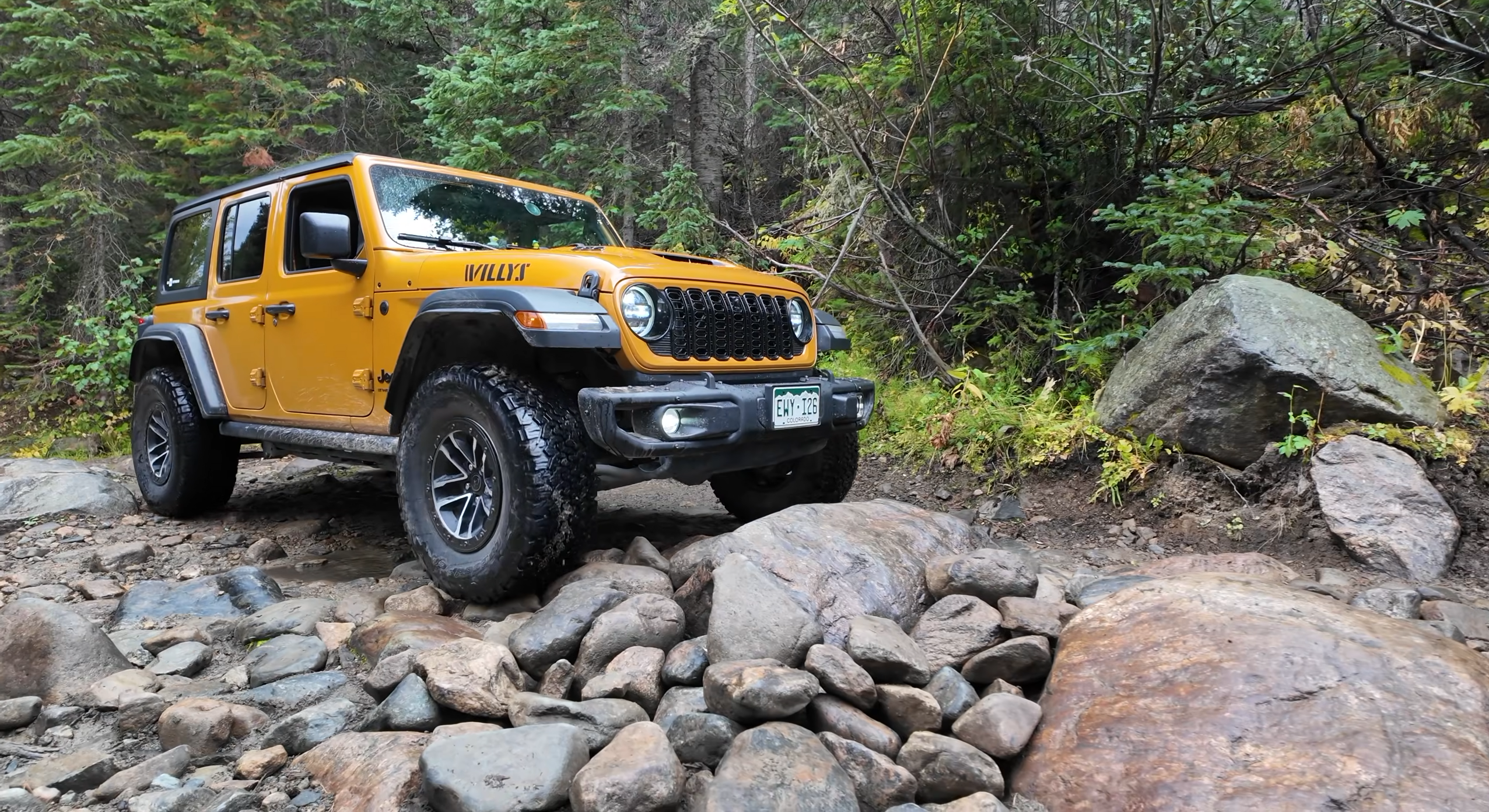
The 392 also provides modern brakes, steering, suspension, safety systems, climate control and a substantially more comfortable cabin. Even a relatively straightforward Wrangler configuration offers a level of refinement that the CJ-2A cannot approach.
Yet the V8 makes the Wrangler more than merely competent. It gives the vehicle a character that makes it particularly appealing to enthusiasts. The 392’s combination of enormous torque, exhaust sound and off-road ability makes it one of the most entertaining versions of the modern Wrangler formula.
The Water Crossing
The comparison became more serious at a water crossing of uncertain depth.
The CJ-2A entered the water with very little margin for error. Its driver had to carefully manage throttle input and avoid throwing water into vulnerable mechanical components. The crossing eventually became deep enough to approach the Jeep’s floor, but the lightweight CJ climbed out successfully.
The Wrangler had far fewer concerns. Its greater ground clearance, modern sealing and electronic systems give it substantially more tolerance for water and difficult terrain.
Both vehicles ultimately completed the crossing, but the experience required considerably more attention from the CJ-2A driver.
Capability Versus Experience
By the end of the trail, the result was clear: the Wrangler 392 is objectively the more capable off-road vehicle in stock form.
It has larger tires, greater clearance, substantially more power, modern suspension technology, advanced traction control and a rear locker. The CJ-2A cannot match those specifications.
But raw capability wasn’t the only conclusion.
The 1947 Jeep provided an entirely different driving experience. Its light weight, mechanical simplicity, open body and exposed controls make the driver an active part of the machine. Every obstacle requires greater involvement. Every mechanical problem becomes a hands-on troubleshooting exercise.
The Wrangler removes much of that burden. It allows the driver to concentrate on the trail rather than the machinery.
That makes the modern Jeep dramatically easier to use, but it also changes the character of the experience.
Eighty Years Later, the Mission Remains
The Middle St. Vrain test illustrates just how far Jeep engineering has progressed without abandoning the original concept.
The CJ-2A was designed as a lightweight, simple utility vehicle capable of traveling where conventional automobiles could not. The Wrangler 392 accomplishes essentially the same fundamental objective with vastly greater power, traction, comfort, reliability and technological sophistication.
The irony is that the older Jeep can sometimes feel more rewarding precisely because it is less capable.
The Wrangler 392 can conquer obstacles that would stop the CJ-2A, and it can do so with considerably less effort. But the 1947 Jeep forces its driver to understand terrain, momentum, wheel placement and the mechanical behavior of the vehicle.
Ultimately, the comparison isn’t really about which Jeep is better. The Wrangler 392 demonstrates how much Jeep has learned in 80 years. The CJ-2A demonstrates why the original formula worked so well in the first place.
On the trail, the Wrangler wins on capability. The CJ-2A wins on involvement—and that distinction may be the most important lesson from putting the two generations side by side.
Source: TFLoffroad