

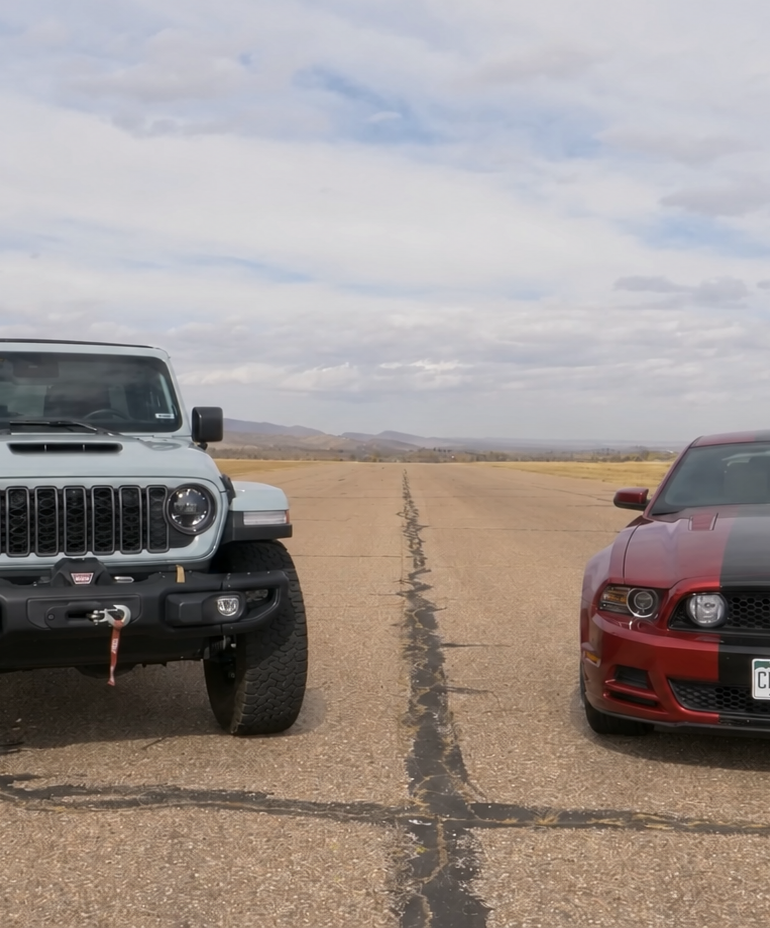
On paper, this matchup makes little sense. One vehicle is a purpose-built American muscle car engineered for speed, handling, and pavement performance. The other is a lifted, body-on-frame off-roader riding on solid axles and all-terrain tires. Yet the arrival of the 2024 Jeep Wrangler 392 has created a fascinating question among enthusiasts: can a V8-powered Wrangler actually outrun a Ford Mustang GT in a drag race?
To find out, the two American performance icons lined up for a series of tests organized by the folks from The Fast Lane Car that includes a standing quarter-mile run, a rolling acceleration race, exhaust evaluation, and emergency braking assessment.
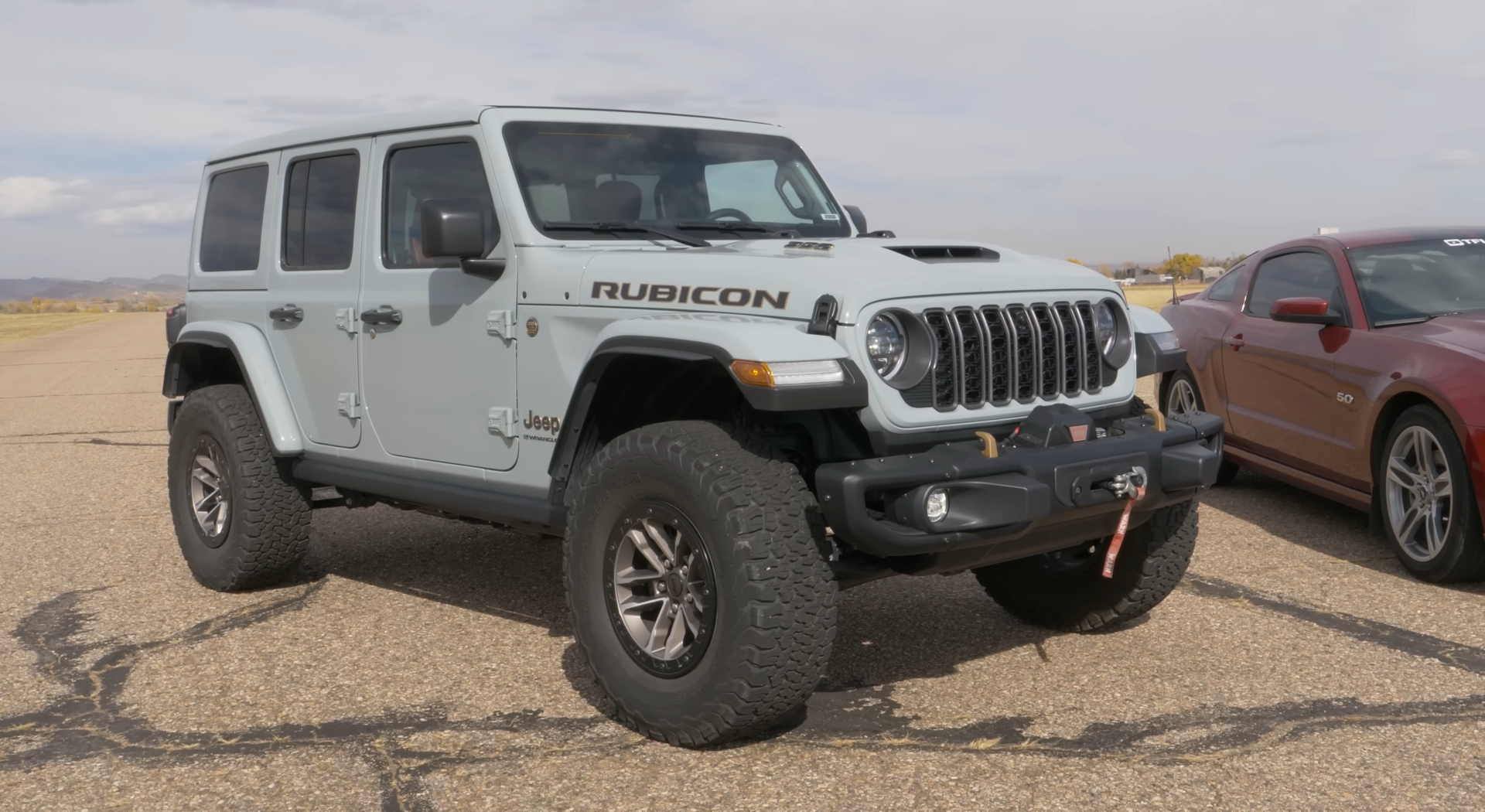
The Jeep Wrangler 392 enters the contest with an impressive arsenal. Under its hood sits a naturally aspirated 6.4-liter HEMI V8 producing 470 horsepower and 470 lb-ft of torque. Power is routed through an eight-speed automatic transmission and Jeep’s sophisticated four-wheel-drive system, giving it a significant traction advantage when launching from a standstill.
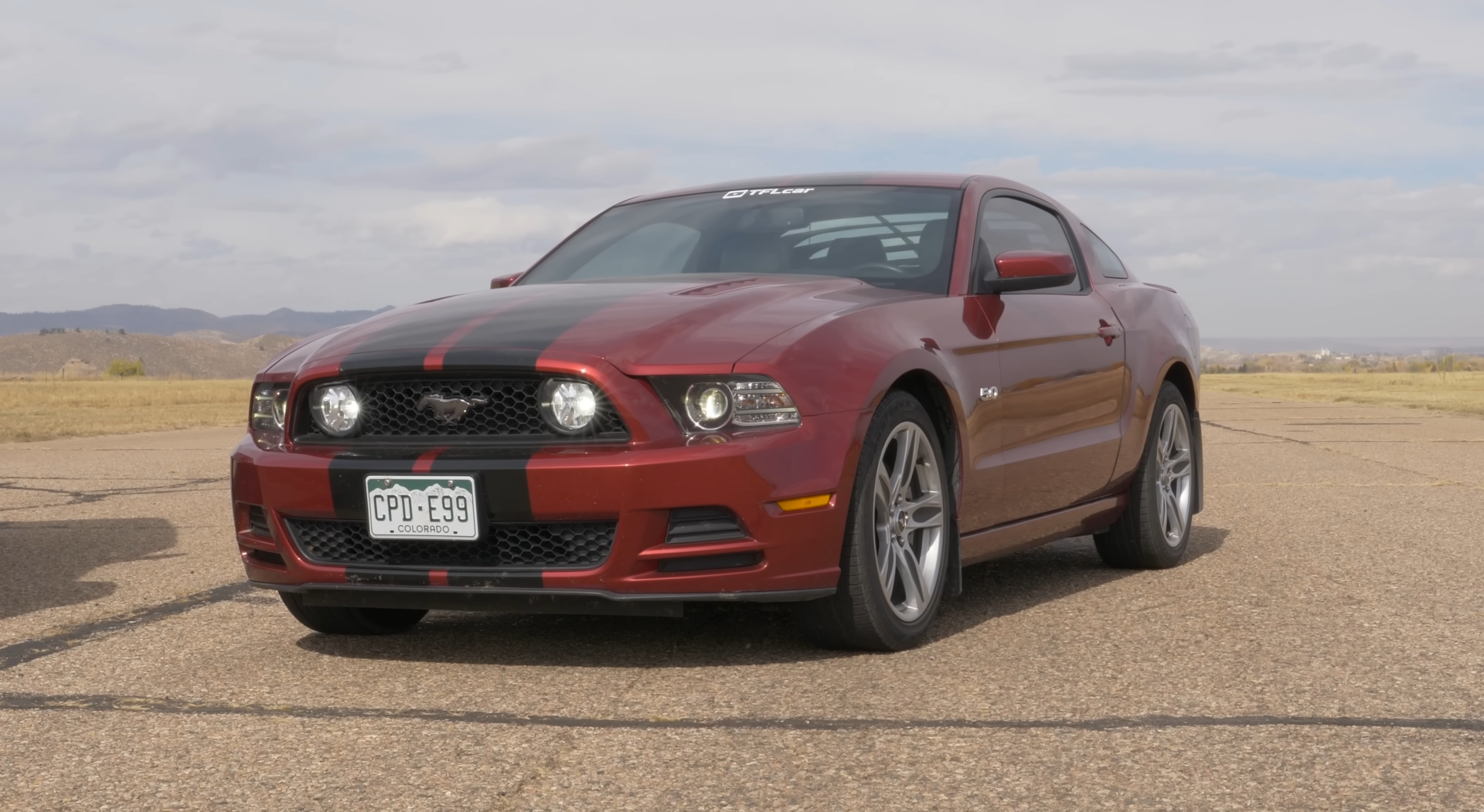
Facing it is the Ford Mustang GT, powered by the renowned 5.0-liter Coyote V8. Despite giving up displacement and torque to the Jeep, the Mustang benefits from a lower curb weight, superior aerodynamics, and a performance-oriented chassis designed specifically for high-speed driving.
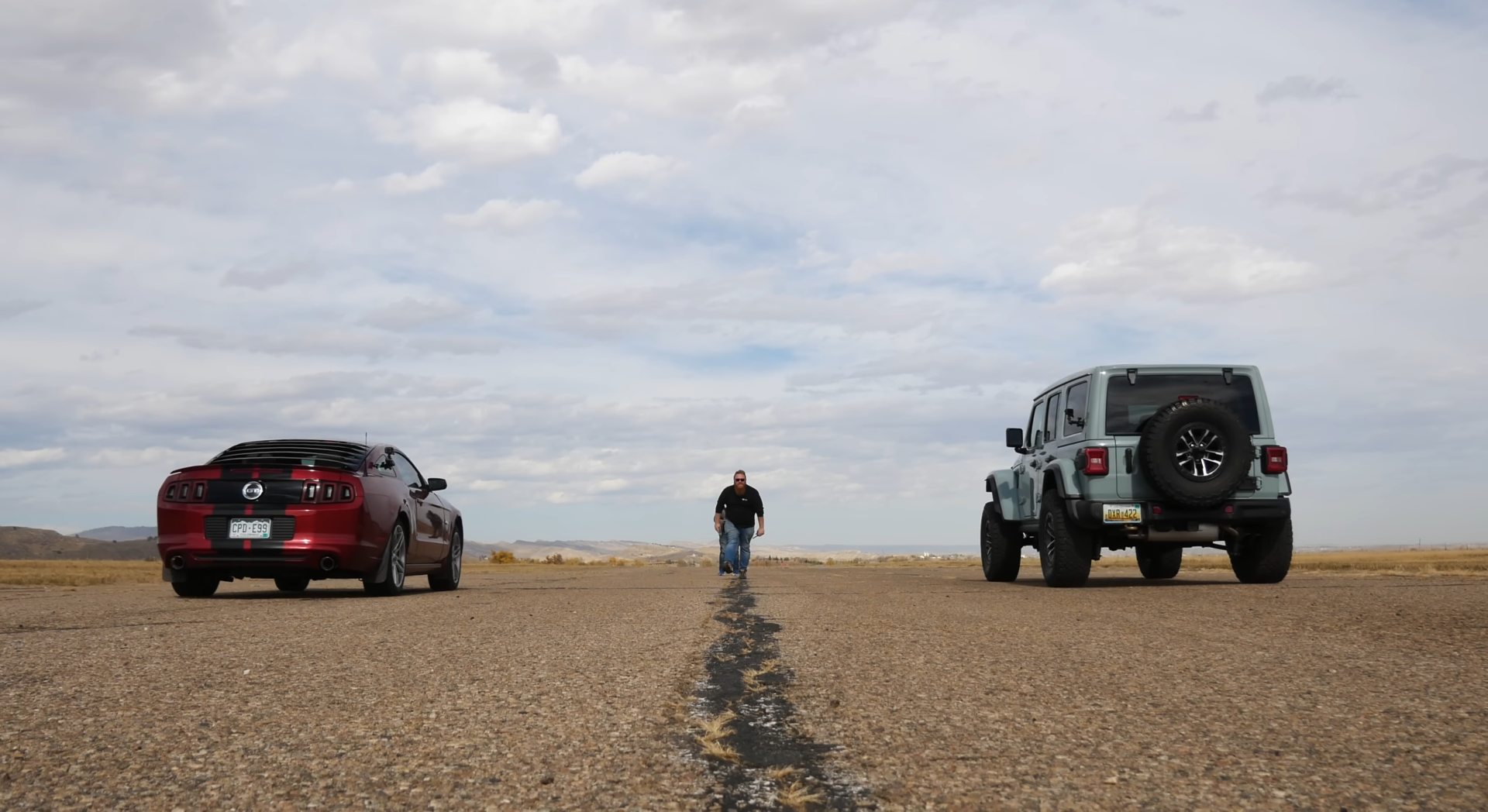
When the lights dropped for the standing quarter-mile race, the Wrangler immediately demonstrated why it has earned a reputation as one of the quickest factory Jeeps ever produced. Its four-wheel-drive system delivered a ferocious launch, allowing it to jump ahead of the Mustang in the opening moments. However, as speeds increased, the Mustang’s lighter weight and aerodynamic efficiency began to pay dividends. The Ford steadily reeled in the Jeep and crossed the finish line first.
The results were remarkably close. The Mustang GT recorded a quarter-mile time of 14.43 seconds, while the Wrangler 392 posted a highly respectable 14.71-second run. For a vehicle shaped more like a brick than a sports car, the Jeep’s performance was astonishingly competitive.
The rolling race further highlighted the strengths of each vehicle. Starting from 30 mph, the Wrangler’s responsive eight-speed transmission and abundant torque allowed it to stay in the fight, but once again the Mustang’s ability to maintain acceleration at higher speeds ultimately secured the victory.
Beyond outright performance, both vehicles showcased distinctly different personalities. The Mustang delivered the classic high-revving soundtrack enthusiasts expect from the Coyote V8, while the Wrangler 392 produced a deeper, more visceral rumble that could be felt as much as heard. In the subjective sound test, the Jeep earned the nod thanks to its thunderous exhaust note.
The final challenge involved emergency braking from 60 mph. Here, physics favored the Mustang. Despite wearing older tires, the Ford stopped in just over 100 feet, roughly 18 feet shorter than the much heavier Wrangler. Considering the Jeep’s substantial weight and off-road-focused tires, its braking performance remained commendable.
Ultimately, the Mustang GT emerged as the performance winner, taking both acceleration contests and the braking test. Yet the true surprise was just how closely the Wrangler 392 competed. Few vehicles weighing this much, riding this high, and capable of tackling serious off-road terrain can stay within striking distance of a dedicated muscle car.
That dual-purpose capability comes at a price. The tested Wrangler 392 carried a sticker approaching $95,000, making it a premium enthusiast toy. Expensive though it may be, the Jeep delivers something increasingly rare in today’s automotive landscape: a V8-powered machine equally comfortable blasting down a drag strip or conquering a trail.
Source: The Fast Lane Car